Public domain · via Wikimedia Commons ↗
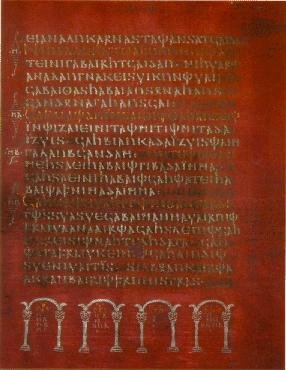
Codex Argenteus
Also called Silver Bible, Wulfila's Bible.
Reflection
In the mid-4th century, the Visigoths — recently arrived on the Roman frontier and increasingly Christian — sent a young man named Ulfilas to be educated at Constantinople. He returned to his people as a bishop and began to translate the Bible into Gothic. The Gothic language did not yet have a written form, so Ulfilas invented one, drawing on Greek and runic letter forms, to render the words of God in the language his people spoke. By his death in 383, much of the Old Testament and most of the New had been translated. The Gothic Bible became the foundational Christian text for an entire family of Germanic tribes.
The Codex Argenteus — the Silver Bible — is what survives. Copied a century and a half after Wulfila, in the Ostrogothic kingdom of Theodoric in Ravenna, it is a luxury production of the highest order: vellum dyed deep purple, text written in silver ink, with the openings of each gospel and the name of Christ marked in gold. The four gospels, in the Western order Matthew–John–Luke–Mark, fill the surviving 188 leaves. The Gothic text reflects a 4th-century Greek exemplar leaning toward what would become the Byzantine text-type, with occasional readings preserved nowhere else.
The codex's history is its own saga. Lost for nearly a thousand years, rediscovered in Werden Abbey in Germany in the 16th century, looted by Swedish troops during the Thirty Years' War in 1648 and brought to Stockholm, eventually deposited at Uppsala University, where it has been preserved with growing care for nearly four hundred years. In 1995, ten leaves missing for centuries were discovered in a chest in Speyer Cathedral.
For the believer today, Codex Argenteus is a witness that the gospel did not stay in Latin or Greek. In the 4th century, while pagan Germanic warriors were raiding the empire, a bishop was inventing an alphabet for them so that they could read the Sermon on the Mount in their own tongue. The Word reaches across boundaries. The Word stands.
Why this manuscript matters
- Wulfila's Gothic Bible
- Silver-and-gold luxury manuscript
- Earliest substantial Germanic-language Bible