Public domain · via Wikimedia Commons ↗
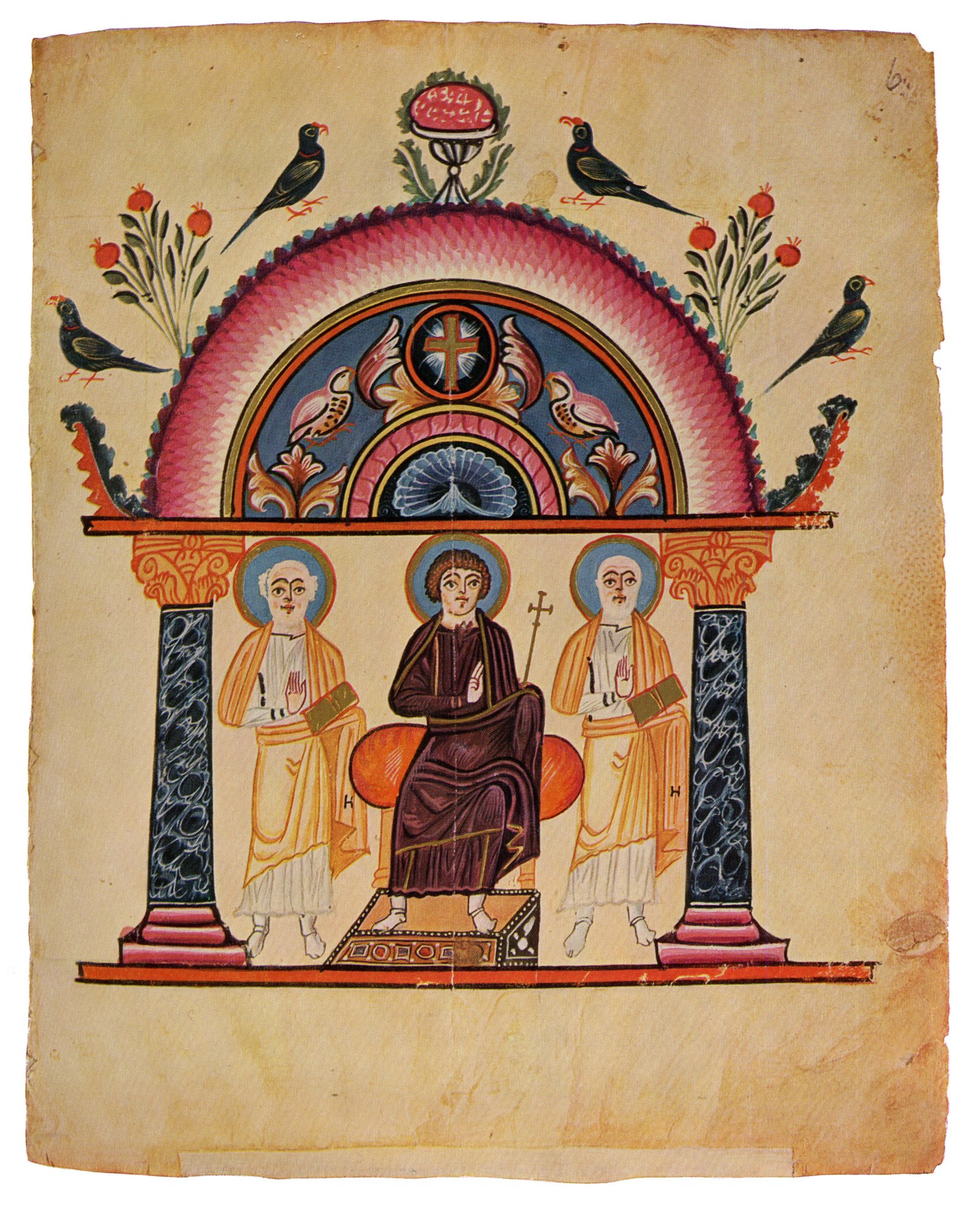
The Echmiadzin Gospels
Also called Etchmiadzin Gospels, Matenadaran MS 2374.
Reflection
Saint Mesrop Mashtots, in the early 5th century, did for Armenian what Wulfila did for Gothic and what Cyril and Methodius would do for Slavic centuries later: he created an alphabet so that the Bible could be translated into the language of his people. Tradition holds that he saw the Armenian letters in a vision. Whatever the means, the Armenian alphabet that Mesrop produced — still used unchanged today, sixteen centuries later — was made for one purpose: to render the Word of God in Armenian. The translation that followed has been called the Queen of the Versions for its precision and its beauty.
The Echmiadzin Gospels are one of the great Armenian biblical manuscripts. The text was copied in AD 989 at the Bgheno-Noravank Monastery, and it preserves the 5th-century Mashtots translation in a careful late-medieval form. The illuminations are extraordinary — canon tables in vivid color, full-page evangelist portraits, ornamental crosses. But the manuscript's most famous feature is its cover: a 6th-century ivory diptych, carved with scenes from the life of Christ, that originally adorned a different book entirely. The cover is older than the text by four hundred years. When the Echmiadzin manuscript was bound, the ancient ivory was repurposed to give the gospels a worthy outer face. The combination — 6th-century cover, 10th-century text, 5th-century translation — is a layered monument to how the Armenian church handled scripture across centuries.
Armenia is the oldest Christian nation in the world. King Tiridates III converted in AD 301, more than a decade before Constantine's Edict of Milan. From that conversion forward, the Armenian church has read the Bible — first in Syriac and Greek, then in Mesrop's translation, then in manuscripts like the Echmiadzin Gospels — without interruption.
For the believer today, the Echmiadzin Gospels are a witness that the gospel went east, climbed the mountains, and shaped a nation that has outlasted every empire that tried to erase it. The Armenian Word stands.
Why this manuscript matters
- Major Armenian Bible witness
- 6th-century ivory cover predates the text
- Mesrop Mashtots tradition