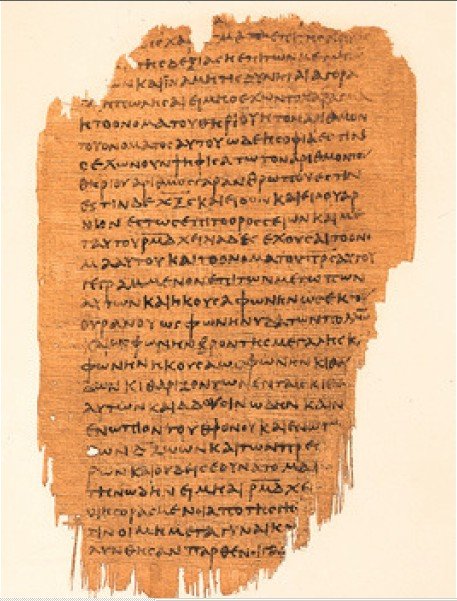
Public domain · via Wikimedia Commons ↗
𝔓47 — Chester Beatty Papyrus III
Also called P47, P. Chester Beatty III.
Reflection
𝔓47 preserves the heart of the Apocalypse. From the fifth trumpet in chapter 9 to the woman riding the beast in chapter 17 — judgment, witness, and warfare unfolding across the great tribulation — these chapters survive on ten papyrus leaves copied in Egypt around AD 250. It is the earliest substantial copy of the book of Revelation we possess.
What 𝔓47 witnesses is that the Apocalypse was being read, copied, and transmitted as scripture in the 3rd-century church, less than two centuries after John saw the visions on Patmos. The text agrees more closely with Sinaiticus than with Vaticanus — Vaticanus has its own peculiarities in Revelation — and represents a stable pre-Byzantine textual stream. The famous passages are here. The seven trumpets. The two witnesses prophesying for 1,260 days. The woman crowned with twelve stars. The beast rising from the sea. The mark on hand or forehead. The Lamb on Mount Zion. All copied here, all received as scripture, all witnessed by a Christian scribe in Egypt three centuries before Constantinople fell silent under iconoclasts.
For the believer today — and this is where the post-tribulation lens matters — 𝔓47 is the manuscript that preserves the trumpet judgments and the testimony of the two witnesses, the events scripture places before the return of Christ. Read in continuity with the Lord's own teaching in Matthew 24, the order is plain: tribulation first, the sun darkened and the stars falling, the sign of the Son of Man in heaven, and then — and only then — the gathering of the elect from the four winds. The same Greek that shows the seven trumpets in 𝔓47 is the Greek that promises the gathering of the saints at the trumpet of God in 1 Thessalonians 4. The church does not escape the great day. The church meets her Lord on it. The Word stands. The trumpet will sound. Be ready.
Why this manuscript matters
- Earliest substantial Revelation manuscript
- Trumpet judgments and beast vision
- Pre-Byzantine text