Public domain · via Wikimedia Commons ↗
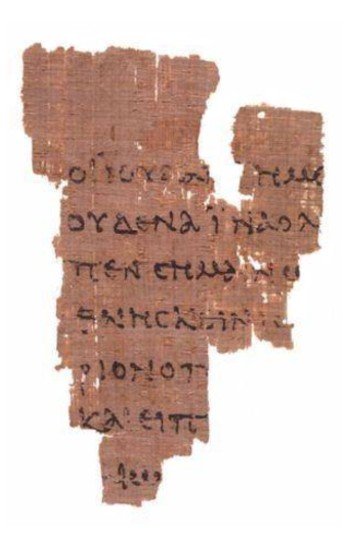
𝔓52 — Rylands Library Papyrus P52
Also called P52, P. Ryl. 457, St John Fragment.
Reflection
It is the size of a credit card. Eight centimeters by six. It is the oldest scrap of the New Testament in existence. On one side: John 18:31–33, where Pilate asks Jesus, "Are you the King of the Jews?" On the other side: John 18:37–38, where Jesus answers, "For this purpose I have come into the world — to bear witness to the truth." And then Pilate's famous question: "What is truth?"
𝔓52 — the Rylands Fragment — was identified in 1934 by C. H. Roberts among an undescribed pile of Egyptian papyri at the John Rylands Library in Manchester. He recognized the script as early-2nd-century, somewhere in the range of AD 100–175. The implications were immediate. The Gospel of John, by the Tübingen school of the 19th century, had been confidently dated as a late 2nd-century composition — too far from Jesus to be a reliable witness. 𝔓52 collapsed that argument in a single afternoon. If a copy of John was already circulating in rural Egypt by AD 125, the original must have been written decades earlier, well within the lifetime of men who knew the apostles. John was not a late legend. John was an early gospel.
This tiny fragment also tells us something about how the early church handled scripture. It is from a codex — written on both sides, with binding holes — not a scroll. The Christian movement adopted the codex form almost immediately, decades before the rest of the Roman world. They were a people of the book in the most literal sense. For the believer today, 𝔓52 is a witness that the gospel you read came from the apostles, not from later editors. The words you read in John 18 — King of the Jews, the witness to truth, what is truth — were on papyrus in Egypt within a generation of the apostle who wrote them. The Word came down. The Word stands.
Why this manuscript matters
- Oldest known NT manuscript fragment
- John 18 — the trial before Pilate
- 2nd-century gospel witness