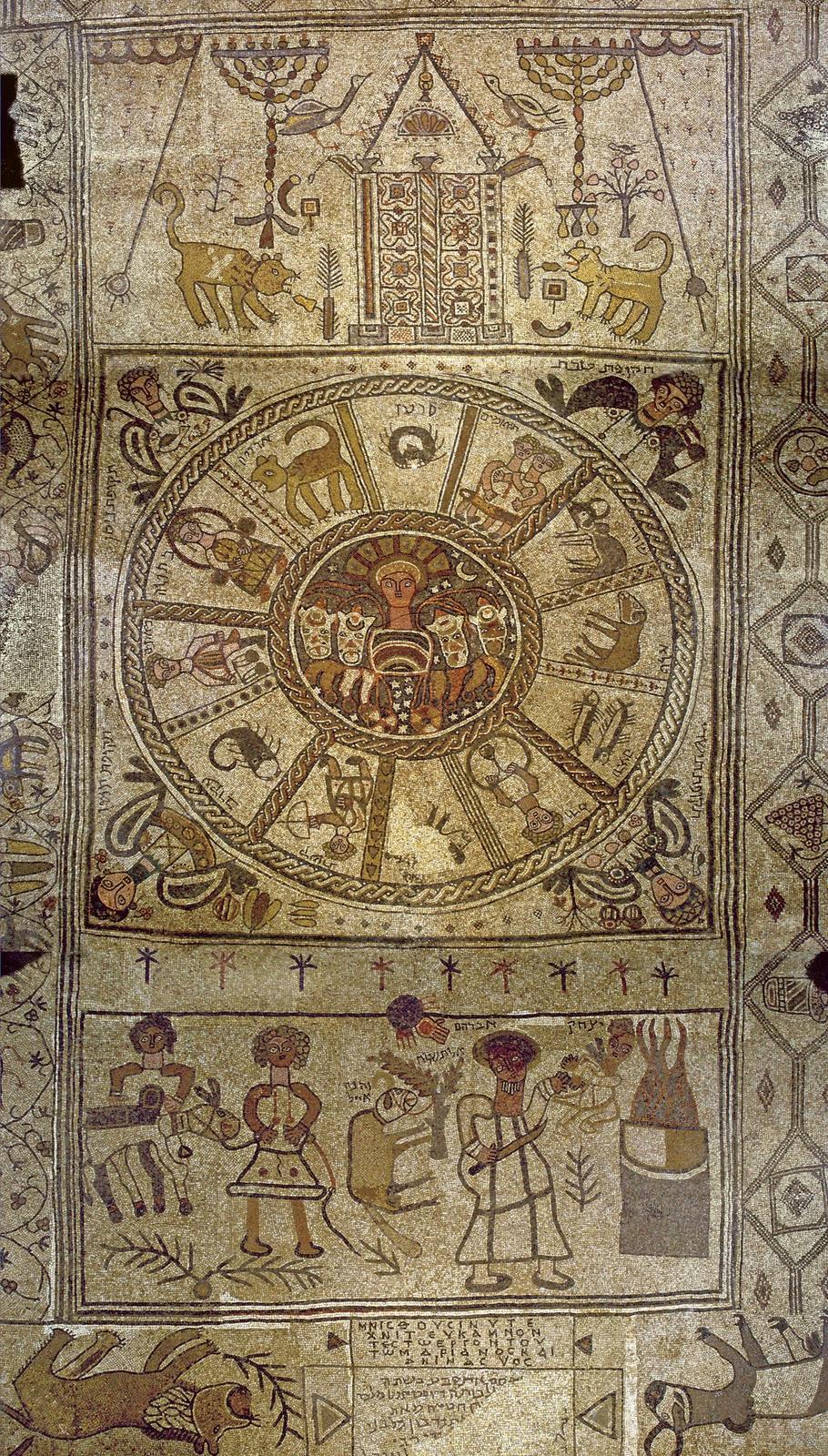
The Beit Alpha synagogue mosaic is one of the finest surviving examples of late antique Jewish synagogue art. Discovered in 1928 by a kibbutz irrigation crew and excavated by Eleazar Lipa Sukenik of Hebrew University, the floor was laid in the early 6th century AD during the joint reign of the Byzantine emperors Justin I and Justinian. The mosaicists Marianos and his son Hanina signed their work in Aramaic and Greek inscriptions at the entrance — a rare survival of named craftsmen from antiquity. The floor is organized in three panels running from the entrance toward the Torah ark. The first panel depicts the Binding of Isaac (the Akedah, Genesis 22) — Abraham with knife raised, Isaac bound, the ram caught in the thicket, and the hand of God restraining Abraham with the Hebrew inscription 'Lay not.' The middle panel is a zodiac wheel with Helios at the center driving a four-horse chariot, and personifications of the four seasons in the corners. The third panel shows a Torah ark flanked by menorot, ritual objects, lions, and curtains. The mosaic confirms two truths that bear directly on the church's doctrine of Israel. First, Jewish life and worship persisted vigorously in the land of Israel through the Byzantine Christian centuries. The synagogue at Beit Alpha was active, decorated, and signed by Jewish craftsmen at the very period when much of the surrounding empire was nominally Christian. Second, the community that built and worshiped there was visibly Jewish — using Aramaic, celebrating Abraham, naming the Torah ark in its iconography — and stood within the line of covenantal continuity Paul describes in Romans 11. The 'remnant according to the election of grace' has names, addresses, and floor mosaics. Sources: E. L. Sukenik, The Ancient Synagogue of Beth Alpha (1932); Steven Fine, Art and Judaism in the Greco-Roman World (revised ed., 2010); Rachel Hachlili, Ancient Mosaic Pavements (2009).
Sixth-century Jewish synagogue floor confirming active Jewish life in the land during the Byzantine period — and the continuity Paul names in Romans 11.