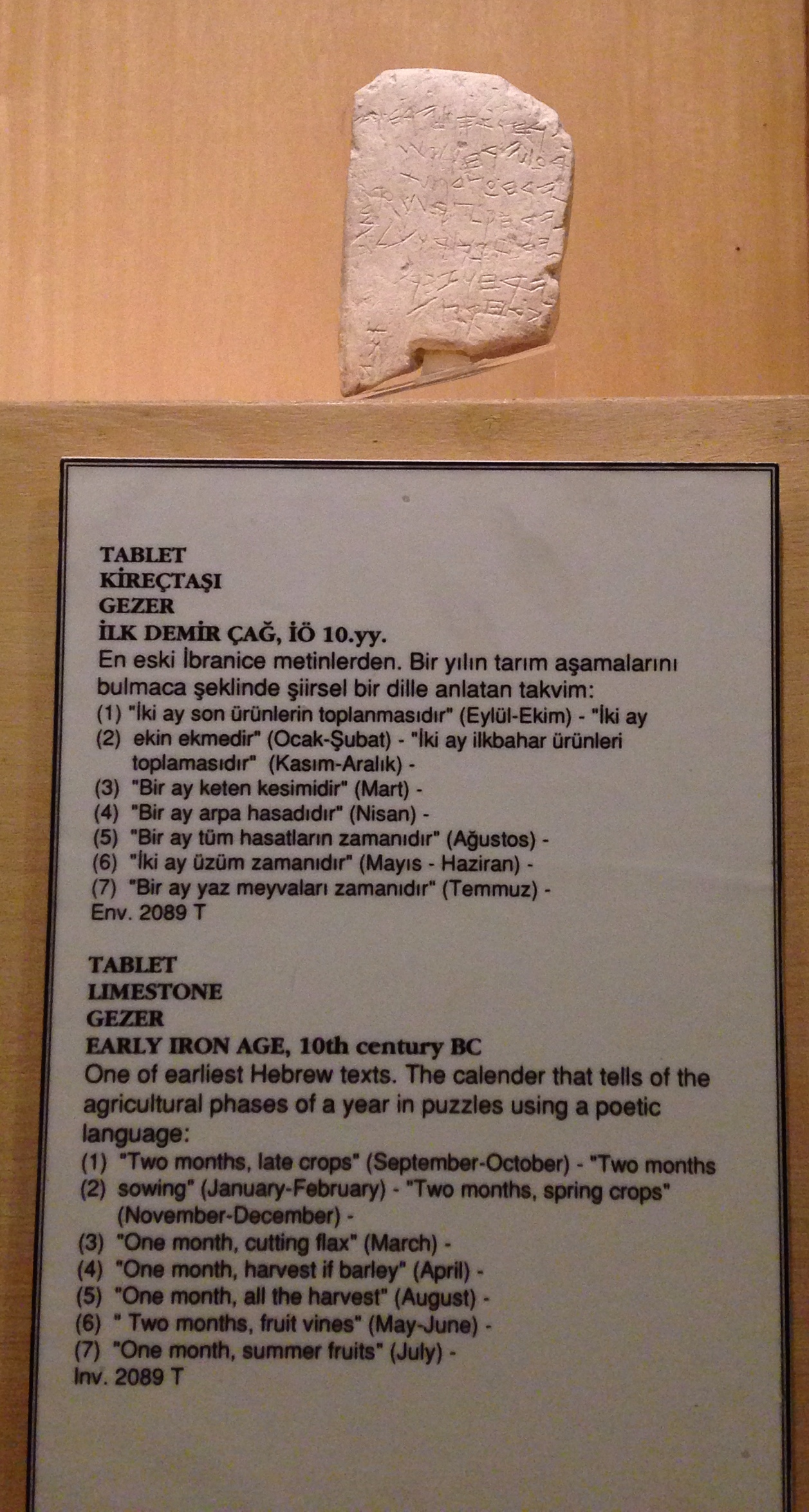
The Gezer Calendar is a small limestone tablet measuring roughly 11 by 7 centimetres, discovered in 1908 by the Irish archaeologist R. A. S. Macalister during the Palestine Exploration Fund's excavations at Tel Gezer. The inscription is widely dated to the second half of the 10th century BC, placing it within the reigns of David and Solomon — and making it the oldest known piece of Hebrew writing in the paleo-Hebrew script that subsequently evolved into the script of the biblical manuscripts. The seven-line text is a simple agricultural calendar, organized by the operations of the farming year: two months of ingathering, two of sowing, two of late sowing, one of cutting flax, one of barley harvest, one of grain harvest and feasting, two of vine-tending, and one of summer fruit. The closing line bears a personal name, 'Abijah,' suggesting the tablet was either a school exercise in which a student wrote out the agricultural year, a tax-collector's mnemonic, or a votive object associated with a particular individual. Several details bear on biblical study. The script is the proto-Canaanite-derived alphabet from which both Hebrew and Phoenician descend, identifying the writer as part of the scribal culture that produced — or was capable of producing — the early monarchic texts of the Hebrew Bible. The agricultural rhythms named in the tablet correspond directly to the festal calendar of Leviticus 23 and Deuteronomy 16, demonstrating that the seasonal world the Mosaic law presupposes was the same world the calendar's writer inhabited. Gezer itself is named repeatedly in Scripture: as one of the Levitical cities (Joshua 21:21), as a fortress city Pharaoh gave to Solomon as part of his daughter's dowry, which Solomon then rebuilt (1 Kings 9:15-17), and as a frontier town between Israel and the coastal Philistines (Judges 1:29). The presence of literate Hebrew administration at Gezer in the 10th century BC matches what 1 Kings reports about Solomon's administrative reach — and stands against minimalist arguments that early Israel was a non-literate tribal society incapable of producing the texts the Bible attributes to its monarchic period. Sources: R. A. S. Macalister, The Excavation of Gezer (1912); William F. Albright, 'The Gezer Calendar,' BASOR 92 (1943); Christopher A. Rollston, Writing and Literacy in the World of Ancient Israel (2010); Jonathan M. Golden, Ancient Canaan and Israel (2004).
Oldest known Hebrew inscription, dating to the 10th century BC — direct evidence of literate scribal culture in the period of David and Solomon.