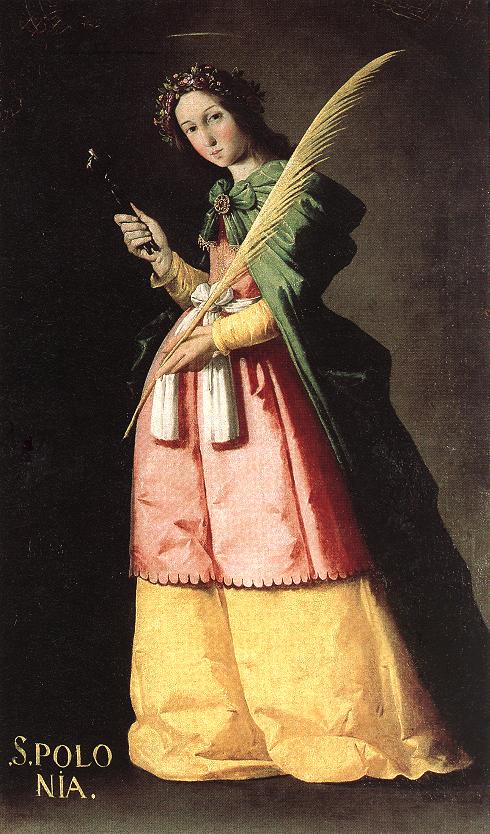
Apollonia of Alexandria
Saint Apollonia
Life and Ministry
Apollonia was an elderly deaconess of the church at Alexandria during the closing years of the emperor Philip the Arab, when Egyptian devotion to the millennial celebration of the founding of Rome boiled over into mob violence against the Christian community. The eyewitness account is preserved in a letter from Dionysius, the bishop of Alexandria during the persecution, which Eusebius copied into his Ecclesiastical History. Dionysius describes Apollonia as a virgin already advanced in years and held in great honor among the believers of Alexandria for her teaching and her care of the poor.
Circumstances of Death
During the popular violence of AD 249 — the year before the formal Decian persecution began — a pagan mob seized Apollonia in the streets, beat her about the face, and broke out all her teeth. They built a pyre outside the city and threatened to burn her alive unless she pronounced the prescribed pagan formula. Dionysius records that she begged for a moment to consider; the mob, supposing she was about to recant, loosened their grip; and Apollonia, an old woman who had spent decades teaching the faith, walked into the flames of her own accord rather than utter the words.
Legacy
Apollonia became one of the most widely venerated of the early Christian women martyrs and was named in many medieval litanies. Her story raised a debated question — was her walking into the fire suicide, or martyrdom? Augustine answered that whatever moves a Christian unbidden by inner inspiration is unwise, but that the church receives Apollonia's act because it was prevented neither by Scripture nor by ecclesiastical correction at the time. She became, by an accident of medieval iconography, the patron of those suffering from toothache and dental disease, on account of the manner of her torture.
Sources
Dionysius of Alexandria, Letter to Fabius of Antioch, preserved in Eusebius, Ecclesiastical History VI.41; Augustine, City of God I.26.