Boniface
Wynfrith of Crediton; Apostle of the Germans
Life and Ministry
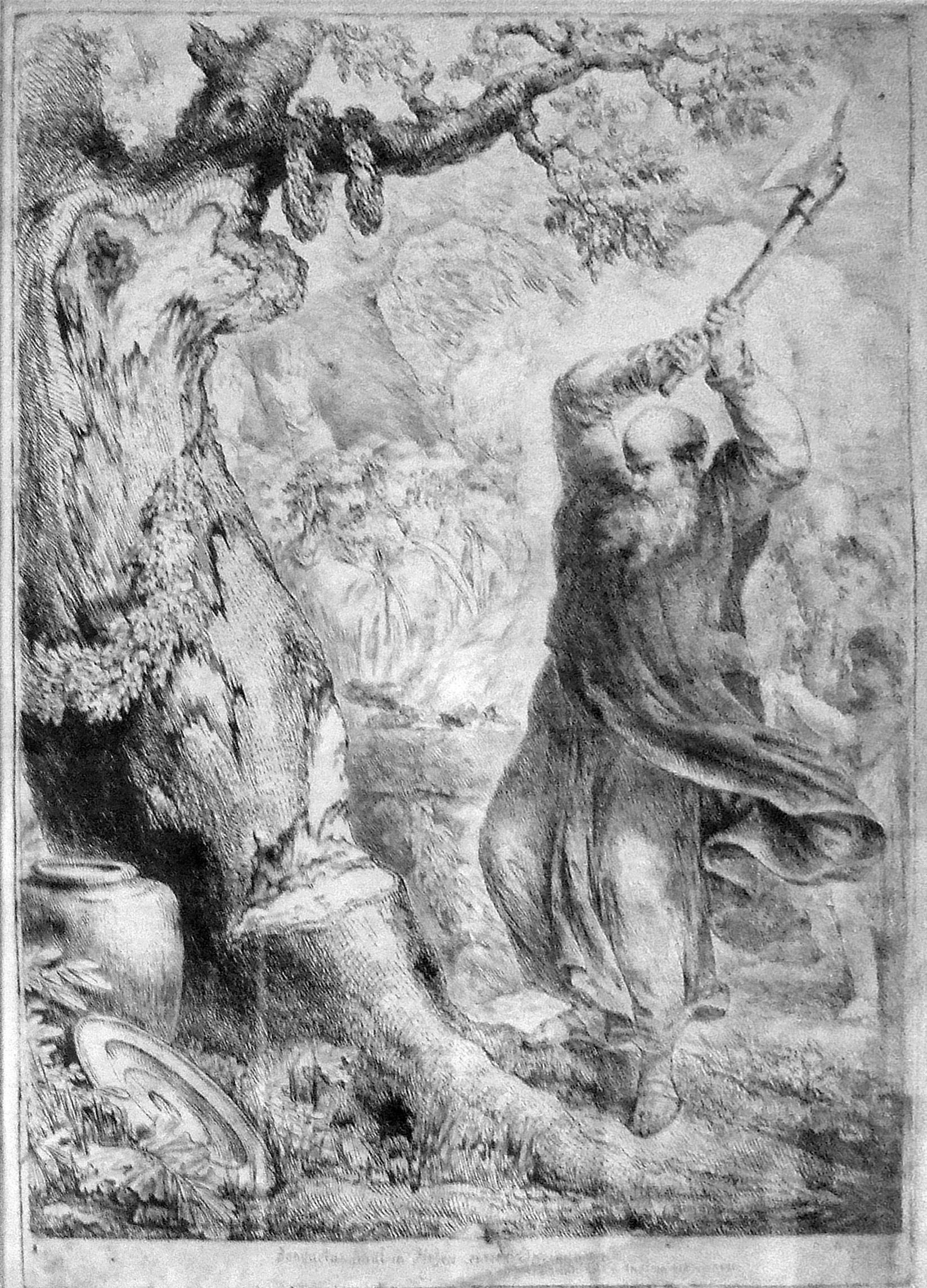
Wynfrith was born in the Anglo-Saxon kingdom of Wessex around AD 675 and entered monastic life as a young man. Trained in scripture and Latin, he was consecrated by Pope Gregory II for missionary work among the still-pagan Germanic peoples east of the Rhine and given the name Boniface. For four decades he traveled through Hesse, Thuringia, Bavaria, and Frisia — preaching, baptizing, founding monasteries (Fulda chief among them), and reorganizing the German church under Roman discipline. The most famous episode of his ministry came at Geismar, where the pagans venerated a great oak called Donar's Oak. Boniface struck it with an axe; the tree fell, by tradition splitting into four equal parts, and the watching pagans, expecting their god to strike him dead, instead saw nothing happen. Many turned to Christ.
Circumstances of Death
Late in life, in his seventies and increasingly frail, Boniface returned to the unevangelized Frisians of the north — the people he had first attempted to reach as a young missionary half a century before. On the morning of June 5, 754, he was waiting near the village of Dokkum to confirm a group of new converts when an armed band of pagan Frisians — accounts vary as to whether they were robbers or religiously motivated raiders — descended on the camp. His companions reached for weapons; Boniface forbade them, telling them to receive death calmly. He was struck down with a sword. A copy of the Gospels he had been holding survives at the Fulda monastery library, slashed through by the blade.
Legacy
Boniface is reckoned the apostle of the Germans; the modern German church traces much of its institutional shape to his work. His correspondence — over 150 surviving letters — gives one of the richest portraits of any eighth-century life. The Ragyndrudis Codex he was reading when killed remains at Fulda as the most concrete relic of any Western martyrdom from the early medieval period. Lutheran tradition counts him as a forerunner; Catholic tradition keeps him as patron of Germany; both inherit the work of his hands.
Sources
Willibald, Vita Bonifatii (c. AD 760, written by his disciple); Boniface, Letters (CCCM); C. H. Talbot, ed., The Anglo-Saxon Missionaries in Germany (Sheed & Ward, 1954).