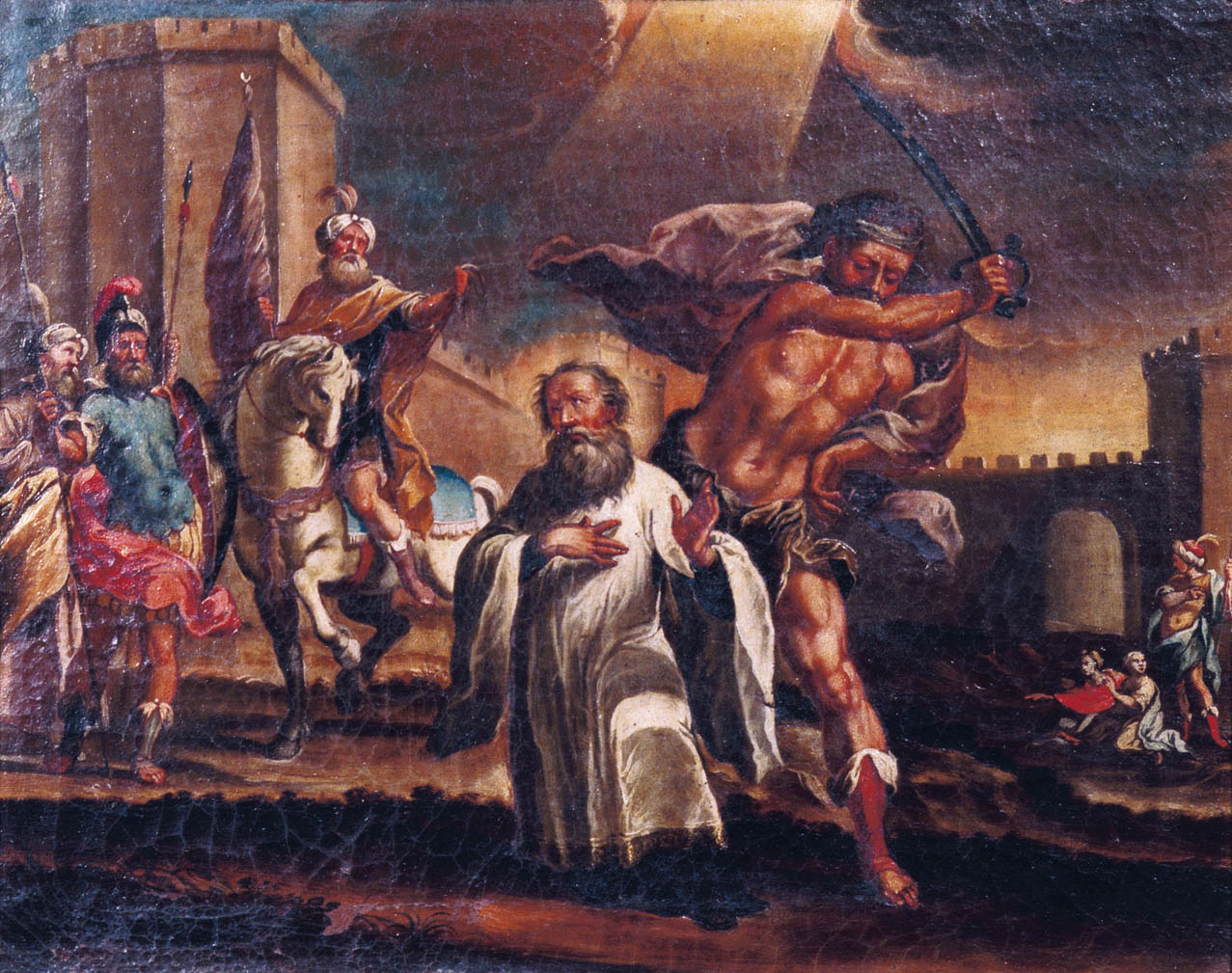
Eulogius of Córdoba
San Eulogio de Córdoba
Life and Ministry
Eulogius was born in Córdoba around AD 800, three generations into the Mozarab settlement that had survived the Umayyad conquest of 711 — Christians who kept their faith, used a Latin-rite liturgy, and spoke a hybrid Arabic-Latin Romance. He took orders, taught at the cathedral school attached to the basilica of San Zoilo, and became a leading figure in the loose group of priests and monks around Abbot Speraindeo who held that the Christian church under the caliphate was being absorbed by quiet stages — through intermarriage, the prestige of the Arabic language, the social rewards of conversion, and the public scorn under which Christian liturgy was tolerated. In 850 a priest named Perfectus was executed for replying truthfully when an Arab crowd asked him what he thought of Muhammad; this began a decade in which roughly fifty Christians of Córdoba went deliberately to the qadi's court and publicly confessed Christ and denounced Muhammad, knowing the penalty was death by beheading.
Circumstances of Death
Eulogius did not seek martyrdom himself but he wrote the record of those who did. His Memoriale Sanctorum (851–856), Documentum Martyriale, and Apologeticus Martyrum survive as the only sustained Latin chronicles of life under early Umayyad rule from inside a Mozarab parish. The Córdoban bishop and the emir cooperated in trying to stop the voluntary martyrdoms; Eulogius was twice imprisoned for refusing to do so. In 859 a young woman named Leocritia, born to Muslim parents but secretly baptized, fled her family and asked Eulogius for shelter. He hid her among friends. They were betrayed within weeks; Leocritia was brought before the qadi and condemned. Eulogius, brought before the same court for harboring her, was offered his life in exchange for a brief conformity. He answered with a short address on the divinity of Christ. He was beheaded on March 11, 859. Leocritia was beheaded four days later and her body thrown in the Guadalquivir.
Legacy
Eulogius is the chronicler-martyr of Al-Andalus — the witness who recorded the voluntary martyr movement of ninth-century Córdoba and was himself swept into it at the end. His writings preserve the only narrative record of Mozarab Christianity at the moment when its capacity to resist absorption was beginning to fail; within two centuries the Mozarab population would shrink to a few northern parishes. Within months of his death the Christian kingdom of Asturias sent envoys to Córdoba to recover his bones and Leocritia's; the relics were taken to Oviedo Cathedral, where they remain. His Apologeticus is the earliest sustained Christian theological response to Islam written in Latin from within a Muslim-ruled society — a literature that resumes only with the Crusader chroniclers two and a half centuries later.
Sources
Eulogius of Córdoba, Memoriale Sanctorum, Documentum Martyriale, and Apologeticus Martyrum (851–857), in Migne PL 115; Paulus Alvarus, Vita Eulogii (c. 860); Kenneth B. Wolf, Christian Martyrs in Muslim Spain (Cambridge, 1988); Janina M. Safran, Defining Boundaries in Al-Andalus (Cornell, 2013), ch. 4.