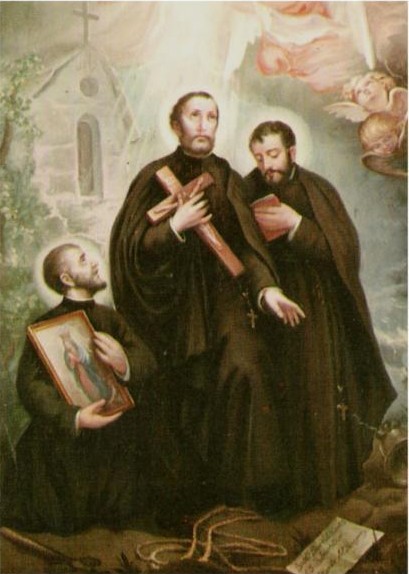
Juan del Castillo
San Juan del Castillo, martyr of Yjuhí
Life and Ministry
Juan del Castillo was born at Belmonte de Tajo near Toledo in AD 1596, studied law at Alcalá, and entered the Society of Jesus at Madrid in AD 1614. Sent to the New World after his philosophical studies, he was ordained at Córdoba in Argentina in AD 1625 and assigned to the Paraguay missions under Roque González. He served at Concepción for two years and in October AD 1628 was placed by González in sole charge of the recently-founded reduction of Yjuhí, a day's journey from Caaró, where about three hundred Guaraní families were being catechized. He was thirty-two years old, fluent in Guaraní, and known among the missionaries for his austerity of life and for his patient instruction of the elderly converts who were the hardest to teach.
Circumstances of Death
News of the killings at Caaró on 15 November reached Yjuhí on the morning of 17 November carried by the warriors of Ñezú themselves, who had ridden through the night to extend the rising. Castillo received them at the chapel; he was seized, beaten with clubs, dragged for nearly a mile by a rope around his neck, and finally killed by stoning. The chapel at Yjuhí was burned, and the catechumens were ordered to renounce their baptism — most refused. (The political dimension here too was real: Ñezú had calculated that the rising at Caaró would collapse the entire reduction system if it were extended quickly, and Yjuhí was the next post on the chain. Castillo, however, was the priest of a settled and willingly catechized community and had no political role.) His body was recovered by Guaraní Christians and buried at Concepción.
Legacy
Castillo completes the three martyrs of the Río de la Plata canonized by John Paul II in AD 1988. He is remembered as the priest of the second day — the man who knew, by the morning of 17 November, that what had happened at Caaró was coming for him, and who did not leave his catechumens. His witness is the witness of the shepherd who stays: Christ is preached not only at the founding of the mission but at its survival, and the chapel that is burned twice is the chapel that has been built on the rock the second time. The Guaraní of Yjuhí buried him at Concepción and went on with the catechism the next week.
Sources
Antonio Ruiz de Montoya, Conquista Espiritual (AD 1639); J. M. Blanco, San Roque González y sus compañeros (1929); Philip Caraman, The Lost Paradise (1975); Barbara Ganson, The Guaraní Under Spanish Rule (2003).