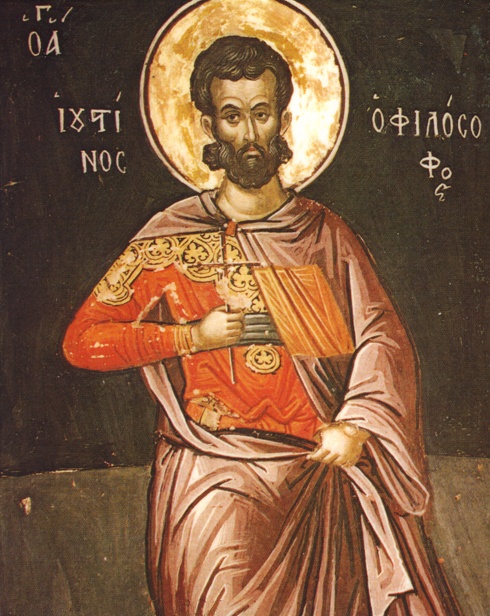
Justin Martyr
Justin of Caesarea; Justin Philosopher
Life and Ministry
Justin was born around AD 100 to a pagan Greek family at Flavia Neapolis in Samaria, the modern Nablus. As a young man he passed through Stoic, Peripatetic, Pythagorean, and Platonist schools in turn, finding none of them satisfying. According to his own account, an old man at the seashore directed him to the Hebrew prophets and to Christ, and Justin's conversion was the conversion of a philosopher who had concluded that the Logos foreshadowed in Plato had become flesh. He kept his philosopher's cloak after his baptism and opened a school in Rome, where he taught Christianity as the true philosophy. He wrote the First and Second Apologies addressed to the emperor Antoninus Pius, defending Christian worship as rational and lawful, and the Dialogue with Trypho, a sustained engagement with a Jewish interlocutor on the messianic reading of the Hebrew scriptures.
Circumstances of Death
Around AD 165, under Marcus Aurelius, Justin and six of his students were arrested in Rome on the testimony of a rival philosopher, Crescens the Cynic, whom Justin had publicly bested in debate. The trial transcript known as the Acts of Justin and Companions survives and is among the earliest authentic Roman court records of a Christian trial. Asked by the prefect Rusticus what doctrines he held, Justin gave a brief credal summary; asked whether he supposed he would ascend into heaven if scourged and beheaded, he answered, "I do not suppose it; I know it." He was beheaded with his students, including a slave girl named Charito.
Legacy
Justin is the first Christian thinker after the apostles to attempt a sustained intellectual case for the faith, and his apologies are the earliest extant defense of the church to the Roman state. His doctrine of the seminal Logos — that fragments of the Word were sown among the philosophers before the incarnation, and that whatever was true in Plato was already Christian in seed — opened a door for the Christian engagement with Greek thought that ran from Clement of Alexandria through Augustine. The court record of his death is the earliest non-fictional Christian martyr-narrative outside the New Testament after Polycarp's.
Sources
Acts of Justin and Companions (court record, c. AD 165); Justin, First and Second Apologies; Justin, Dialogue with Trypho; Eusebius, Ecclesiastical History IV.16.