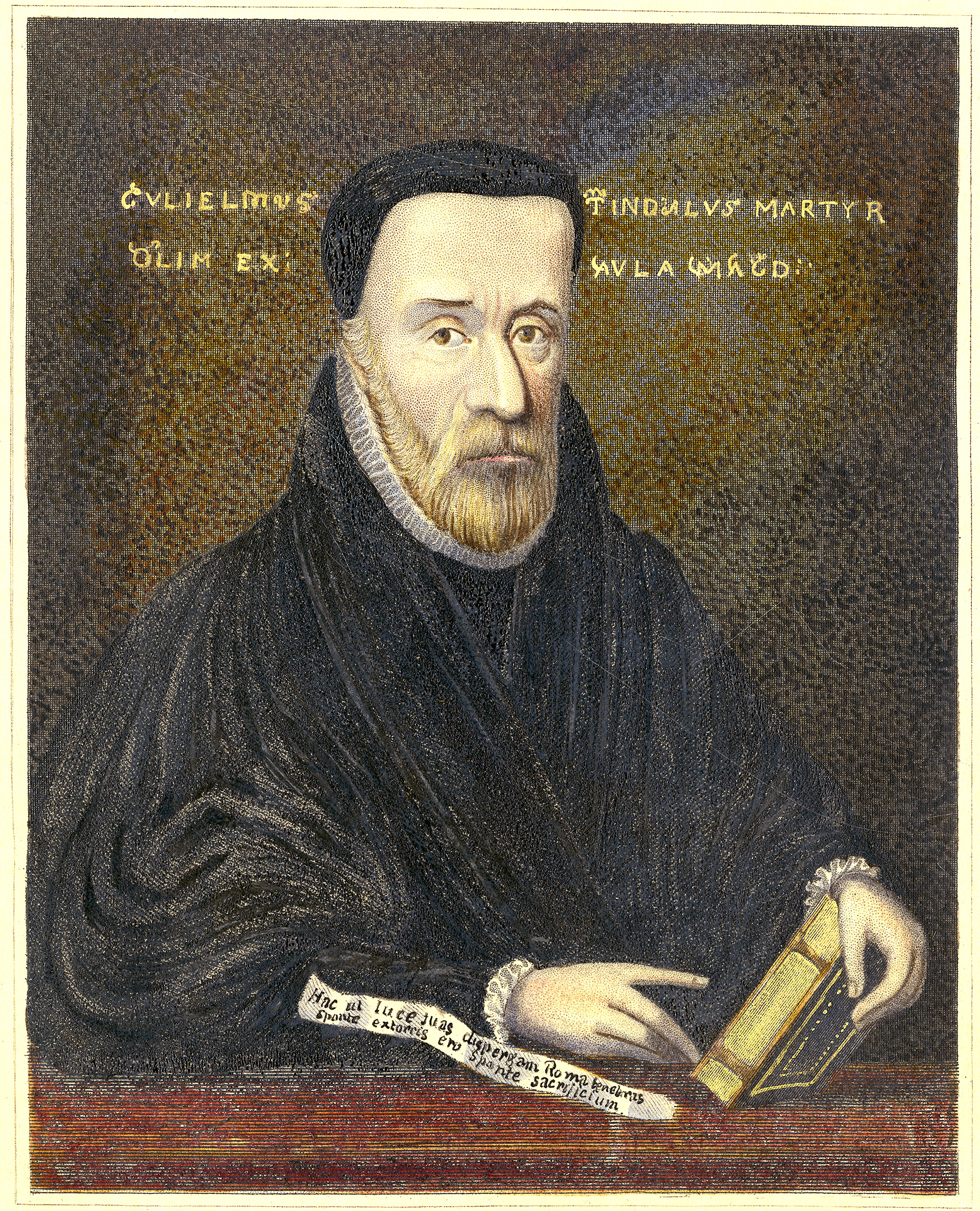
William Tyndale
William Hychyns
Life and Ministry
Tyndale was born in Gloucestershire around 1494, educated at Oxford and Cambridge, and ordained as a priest. Convinced that England's spiritual ignorance grew from the people's lack of access to Scripture in their own tongue, he sought permission from the Bishop of London to translate the New Testament into English; permission was refused. He left England in 1524 and never returned. From Hamburg, Cologne, Worms, and finally Antwerp, working largely alone, he produced the first English New Testament translated directly from the Greek (1526), revised it twice, translated the Pentateuch and Jonah from Hebrew, and laid the manuscript groundwork for much of the Old Testament before his arrest. His phrasing — the powers that be, let there be light, my brother's keeper, the salt of the earth — entered the English language and stayed when other translators borrowed his work into the Great Bible, the Geneva Bible, and finally the King James Version of 1611.
Circumstances of Death
Tyndale was betrayed in Antwerp by a young Englishman named Henry Phillips, who befriended him under false pretenses and led him into the hands of imperial agents. He was held at Vilvoorde Castle near Brussels for over a year, during which he wrote a surviving letter asking for a warmer cap, a coat, and his Hebrew Bible, grammar, and dictionary, that he might continue his work. He was tried for heresy under imperial law, convicted, defrocked, and on October 6, 1536, brought to the stake. As an ordained priest he was granted the courtesy of strangulation by garrote before the fire; eyewitnesses report that with his final breath he cried, Lord, open the king of England's eyes. Within four years, an English Bible — built largely on Tyndale's labor — was placed by royal injunction in every parish church in the realm.
Legacy
Tyndale's translation is, more than any other single source, the linguistic foundation of the English Bible and a major shaping force on the English language itself. By widely cited estimates, roughly four-fifths of the King James New Testament reproduces Tyndale's phrasing. His prayer at the stake was answered within the lifetimes of those who heard it. He died for an act — translation — that within a generation became unremarkable in every Protestant land, and his work made it so.
Sources
John Foxe, Acts and Monuments (1563), Tyndale's biography; Tyndale's surviving letters and prefaces (Parker Society edition, 1848); David Daniell, William Tyndale: A Biography (Yale, 1994); Brian Moynahan, God's Bestseller (St. Martin's, 2003).