Public domain · via Wikimedia Commons ↗
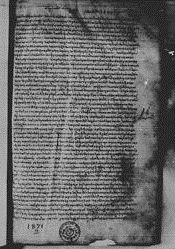
Minuscule 33 — Queen of the Cursives
Also called GA 33, Codex Colbertinus 2844.
Reflection
The minuscule manuscripts of the New Testament — small, cursive, mostly post-9th-century — number in the thousands. Most carry the Byzantine text, the standardized stream that became dominant in the medieval Greek church. Most are repetitive. Most are useful but not pivotal for textual criticism. Then there is Minuscule 33.
Dated to the 9th century, Minuscule 33 carries a New Testament text that aligns extraordinarily closely with Sinaiticus and Vaticanus — the great Alexandrian uncials. Where the Byzantine majority of minuscules has been smoothed and harmonized, Minuscule 33 preserves the harder, shorter, older readings. The German textual critic Johann Eichhorn called it the queen of the cursives. The title has stuck. In modern critical editions, Minuscule 33 is the most consulted Greek minuscule for variant analysis, and its agreement with the Alexandrian witnesses is treated as significant evidence for original readings.
The story this manuscript tells is preservation through unlikely channels. By the 9th century, the Byzantine text dominated. The Alexandrian text-type, fading from the great church centers, survived in the great codices that had moved out of Egypt centuries before. But somehow, in some scriptorium, a scribe in the early Middle Ages had access to an exemplar carrying the older Alexandrian readings — and copied them faithfully into a new minuscule codex. We do not know who. We do not know where. We do know what the scribe gave us: a 9th-century witness to the same text the church received in the 4th.
For the believer today, Minuscule 33 is the witness that God's preservation of his Word does not depend on dominance. The majority text is the Byzantine; the older text is the Alexandrian. Both reach you in your modern Bible because preserving the Word does not require unanimity. It requires faithfulness — even of one anonymous scribe in the 9th century, copying carefully from an exemplar he could no longer fully identify. The Word stands.
Why this manuscript matters
- Closest minuscule to the Alexandrian uncials
- 9th-century witness
- Queen of the Cursives