Public domain · via Wikimedia Commons ↗
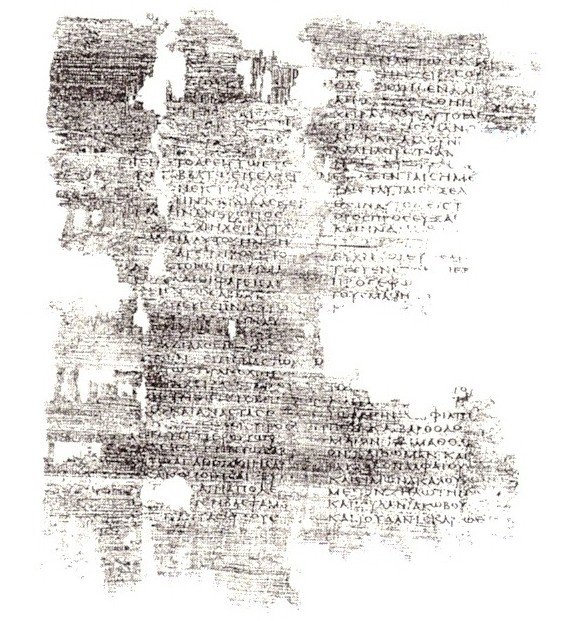
𝔓4 + 𝔓64 + 𝔓67 — The Magdalen / Paris / Barcelona Witness
Also called P4, P64, P67, P. Magdalen Gr. 17, P. Barc. 1.
Reflection
Three fragments scattered across three countries. 𝔓4 in Paris. 𝔓64 in Oxford. 𝔓67 in Barcelona. For decades they were catalogued as three separate manuscripts — 𝔓4 dated to the early 3rd century, 𝔓64 to the late 2nd, 𝔓67 unsure. Then, in 1995, the British papyrologist T. C. Skeat published a study arguing on physical and paleographic grounds that all three fragments belong to a single codex, a single Christian book copied around AD 200 in Egypt. Most scholars have accepted his reconstruction.
If Skeat is right, this scattered codex is something extraordinary: possibly the earliest known four-gospel codex, predating 𝔓45 by half a century. The surviving leaves carry text from Matthew 3, 5, and 26 and from Luke 1 through 6. If a codex this early was already binding Matthew and Luke into a single volume, the canonical four-gospel collection was forming faster than older critical scholarship admitted. Skeat himself argued the original codex would have held all four gospels, given the page layout and likely length.
What the fragments preserve is precious. The Beatitudes from the Sermon on the Mount. The institution of the Lord's Supper from Matthew 26. The angel's announcement to Mary in Luke 1. The presentation of the infant Jesus in the temple. The temptation in the wilderness. The first calling of the disciples. The call of Levi. From the earliest Lukan birth narratives to the Last Supper, the fragments show that the foundational scenes of the gospel — incarnation, kingdom teaching, atoning sacrifice — were already received as continuous, canonical Scripture in the late 2nd century.
For the believer today, 𝔓4 + 𝔓64 + 𝔓67 is a quiet witness against late-canon skepticism. Long before councils and canon lists, the gospels were already a book. The book is in your hands. The Word stands.
Why this manuscript matters
- Possible earliest four-gospel codex
- Combined Matthew–Luke witness
- T. C. Skeat reconstruction