Public domain · via Wikimedia Commons ↗
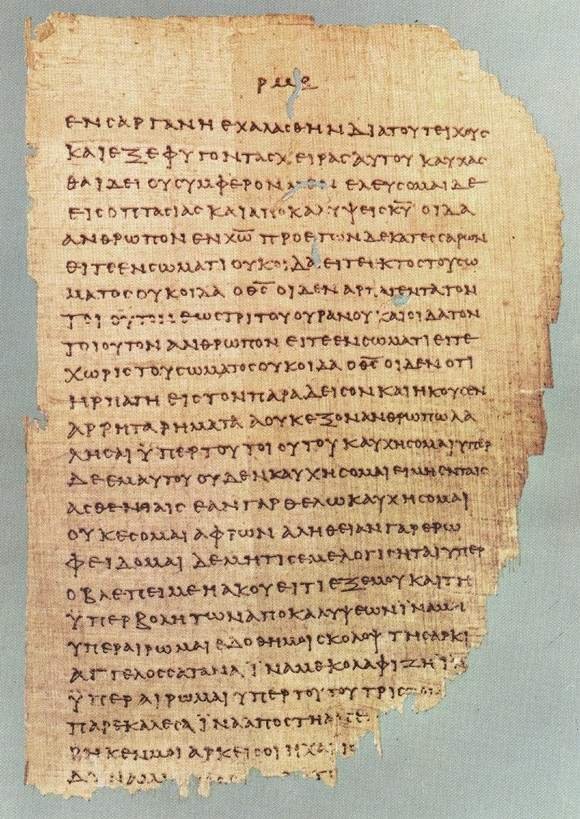
𝔓46 — Chester Beatty Papyrus II
Also called P46, P. Chester Beatty II, P. Mich. Inv. 6238.
Reflection
When Frederic Kenyon announced the Chester Beatty Papyri in 1931, scholarship on the New Testament shifted ground. Before that announcement, the oldest substantial copies of Paul's letters were 4th-century — Sinaiticus and Vaticanus, written under Constantine's patronage. After 1931, the oldest substantial Pauline corpus was 𝔓46, dating to around AD 200. A century and a half had collapsed.
𝔓46 is the earliest manuscript that lets us read Paul as a collection. Romans, 1 and 2 Corinthians, Galatians, Ephesians, Philippians, Colossians, 1 Thessalonians, and Hebrews — all in a single codex, all copied by a single scribe, all preserved with most of their text intact. The text-type is essentially Alexandrian; where 𝔓46 disagrees with later manuscripts, modern critical editions usually side with 𝔓46. It is a primary witness for nearly every Pauline passage.
Two features deserve attention. First, Hebrews stands in the Pauline corpus, placed immediately after Romans. The early church received Hebrews as Pauline-tradition, not as an anonymous outlier. Second, the Pastoral Epistles are not present in what survives — but the surviving codex is missing leaves at both ends, so absence is not proof. Liberal scholars have used 𝔓46 to argue against Pauline authorship of the Pastorals; the manuscript itself proves no such thing. What 𝔓46 does prove is that by AD 200, Christians in Egypt were reading a unified collection of Paul's letters as a single book of scripture.
For the believer today, 𝔓46 means the gospel of justification by faith, the resurrection chapter of 1 Corinthians 15, the kenosis hymn of Philippians 2, the body-of-Christ teaching of Ephesians — all of it was already canonical, already circulating, already shaping the early church within 150 years of the cross. Paul did not need centuries to be received as scripture. He was scripture from the start. The Word stands.
Why this manuscript matters
- Oldest substantial Pauline corpus
- Hebrews placed with Paul
- Earliest witness to Romans, 1–2 Cor, Galatians