Public domain · via Wikimedia Commons ↗
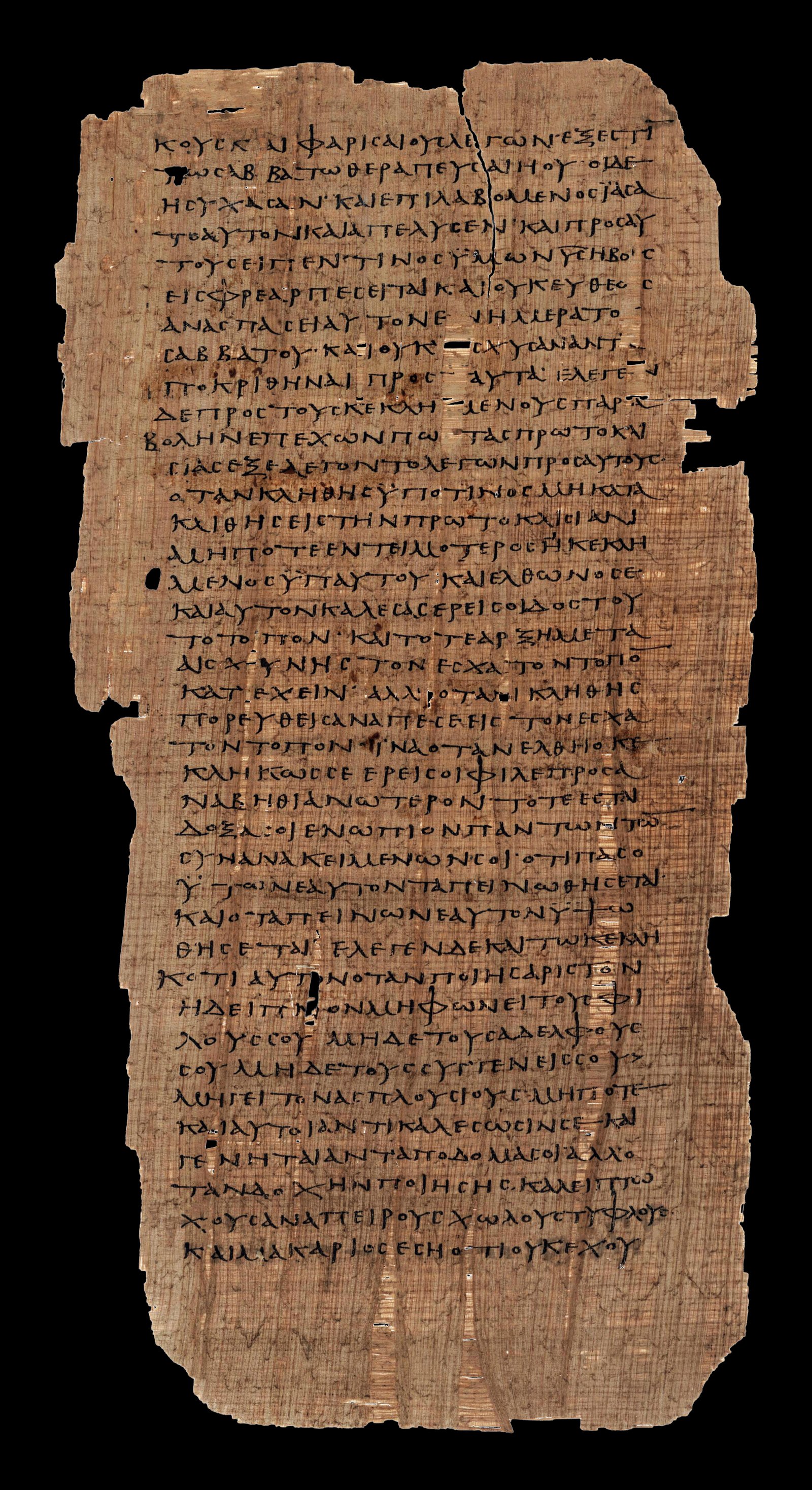
𝔓75 — Bodmer Papyrus XIV–XV
Also called P75, P. Bodmer XIV–XV, Hanna Papyrus 1.
Reflection
Before 𝔓75 was identified in the 1950s, a theory floated through scholarship that the text-type behind Codex Vaticanus — the so-called Alexandrian text-type, prized for its discipline and antiquity — was actually a late editorial recension, polished into shape in the 4th century by Christian scholars at Alexandria. 𝔓75 ended that theory.
What the manuscript shows is that the text in Codex Vaticanus, copied around AD 350, is substantially identical to a manuscript copied 150 years earlier in Egypt. The Alexandrian text was not invented in the 4th century. It was already there in the 2nd. Where 𝔓75 and Vaticanus differ from each other, the differences are small and orthographic. Where they agree, they agree across whole chapters of Luke and John — agreement so close that scholars now treat 𝔓75 and Vaticanus as essentially representing the same textual stream, separated by a century and a half but copying the same exemplar tradition with very high fidelity.
The practical consequence is enormous. The text of Luke and John in your modern Bible — the parable of the Prodigal Son, the road to Emmaus, the high priestly prayer, the resurrection appearances — comes overwhelmingly from this text-type. 𝔓75 demonstrates that this text was already stable, already widely copied, already in circulation in Egypt within a century of the apostles' generation. We are not relying on a 4th-century editorial guess. We are relying on a 2nd-century copy of an exemplar tradition that goes back to the writing of the gospels themselves.
For the believer today, 𝔓75 is the proof that the Lukan birth narrative, the Johannine prologue, the woman at the well, the raising of Lazarus, and the empty tomb were preserved in a stable, disciplined form within decades of the apostles' deaths. The text the church canonized is the text the church received. The Word stands.
Why this manuscript matters
- Closest text to Codex Vaticanus
- Earliest substantial Luke witness
- Disproved theory of late Alexandrian recension