Public domain · via Wikimedia Commons ↗
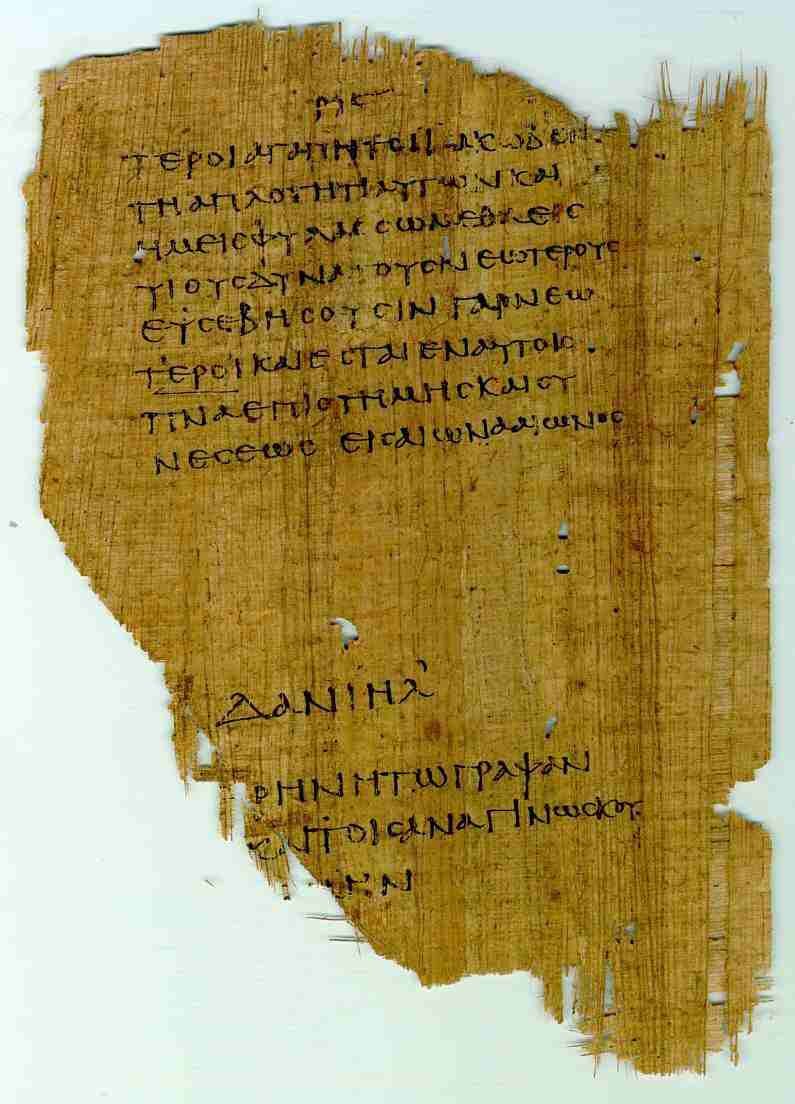
Papyrus 967
Also called P967, Rahlfs 967.
Reflection
By the time the great Christian uncials were being copied — Sinaiticus, Vaticanus, Alexandrinus — the Old Greek translation of Daniel had largely been replaced in the Christian churches by a different translation, the recension of Theodotion. The Old Greek of Daniel had survived in only two minor channels. Then, in the 1930s, Papyrus 967 was identified — and the Old Greek of Daniel returned in full substance, copied around AD 200 in Egypt, before Origen's Hexaplaric revisions had reshaped Christian Greek scripture.
What Papyrus 967 witnesses is the earliest accessible form of the book of Daniel in Greek. The Old Greek differs from Theodotion in places — sometimes by paraphrase, sometimes by a different reading of the Hebrew or Aramaic, sometimes by additions in the deuterocanonical sections (Susanna, Bel and the Dragon, the Prayer of Azariah). For the Protestant canonical lens, the deuterocanonical additions remain non-canonical; Papyrus 967 witnesses their presence in some early Christian manuscripts of Daniel without altering that judgment. What it does affect is the textual understanding of canonical Daniel itself — the kingdoms vision of chapter 7, the ram and goat of chapter 8, the seventy weeks of chapter 9, the great war of chapter 11.
The order of chapters in Papyrus 967 is unusual: Daniel 7 follows Daniel 8, not the other way around. Whether this reflects a Hebrew exemplar with a different chapter sequence or an editorial choice is debated. Either way, the kingdoms unfolded as the Old Greek translator received them are essentially the kingdoms of our text.
For the believer today — and this is where eschatology surfaces — Papyrus 967 is a witness that the Daniel the apostles read in Greek, the Daniel the Lord himself referenced in the Olivet Discourse when he spoke of the abomination of desolation, was already in Christian hands within a century or two of the apostles. The seventy weeks. The little horn. The fourth kingdom. The great day. The text the prophet wrote is the text the church received. The Word stands. Watch and pray.
Why this manuscript matters
- Pre-Hexaplaric Old Greek Daniel
- Earliest substantial Daniel manuscript
- Distinctive Ezekiel text