Public domain · via Wikimedia Commons ↗
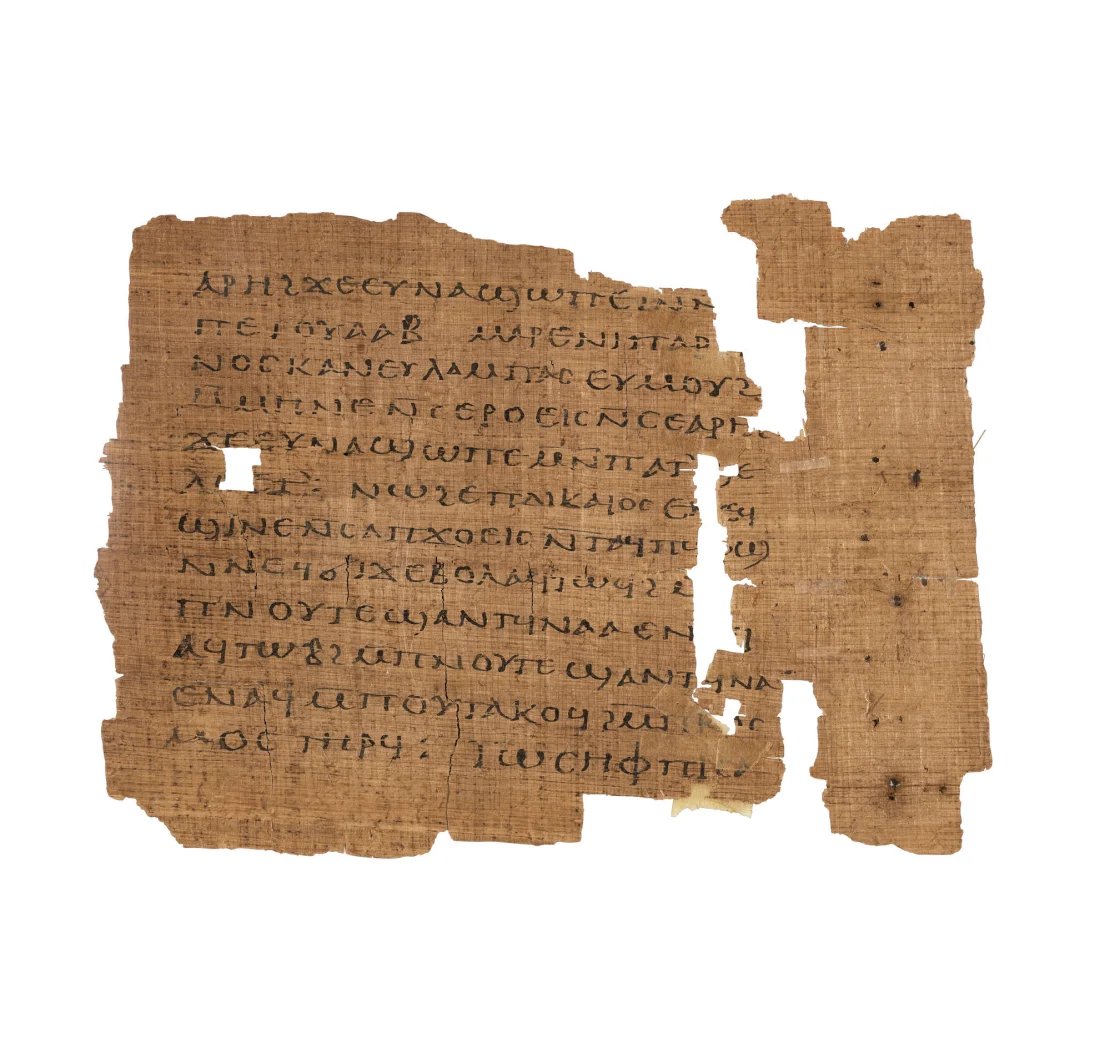
Sahidic Coptic New Testament — Crosby-Schøyen Codex
Also called Crosby-Schøyen Codex MS 193, Sahidic NT.
Reflection
The Christianity of Roman Egypt was not only Greek. Beneath the Greek-speaking cities — Alexandria, Oxyrhynchus, Memphis — lay the Egyptian-speaking countryside, where the descendants of the Pharaohs' subjects spoke Coptic, the late form of the ancient Egyptian language. When the gospel reached those villages, it had to be translated. The Sahidic dialect of Coptic, spoken in Upper (southern) Egypt, became the literary language of the Egyptian church. By the 3rd century, the New Testament was being read in Sahidic.
The Crosby-Schøyen Codex is one of the earliest surviving Christian books in any language — a 3rd- or 4th-century papyrus codex containing 1 Peter complete, Jonah, a portion of 2 Maccabees, Melito of Sardis's Homily on the Passover, and an unidentified homily. It is a Sahidic anthology, the kind of book a small Egyptian-speaking Christian community would gather for reading and instruction. The presence of 1 Peter in Sahidic, copied in this period, is itself evidence of the early translation of the New Testament into Coptic.
The broader Sahidic New Testament — preserved across hundreds of subsequent manuscripts — is a primary witness to the Alexandrian text-type. Its readings often agree with Sinaiticus and Vaticanus, sometimes against them, and when modern critical editions weigh variants, the Sahidic version is consulted as an independent line of transmission. The translators were careful. They were not paraphrasing. They were rendering Greek into Coptic word-for-word where Coptic grammar permitted, and idiomatically where it did not.
For the believer today, the Sahidic New Testament is a witness that the gospel does not stay in the language of the elite. It moves into the languages of villages and farmers and people who do not read Greek. Within three centuries of Pentecost, an Egyptian peasant could hear 1 Peter in his own tongue. The Word goes to the village. The Word stands.
Why this manuscript matters
- Earliest substantial Coptic biblical text
- 1 Peter in Sahidic
- Egyptian vernacular Christianity