Public domain · via Wikimedia Commons ↗
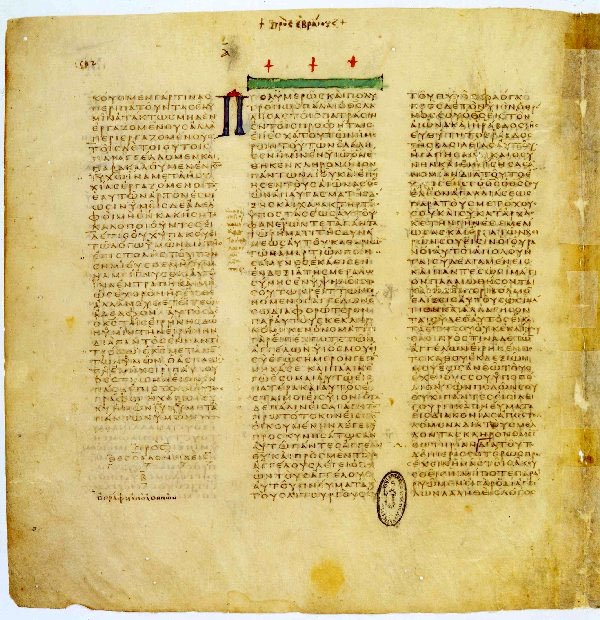
Codex Vaticanus
Also called B, 03, Vaticanus, Vat. gr. 1209.
Reflection
Codex Vaticanus has been on the shelves of the Vatican Library at least since 1475. The library's first surviving catalog, drawn up that year, lists it. Where it was before — Caesarea, Alexandria, Constantinople — we can only guess. What we know is that it is, alongside Sinaiticus, one of the two oldest near-complete Greek Bibles in existence, copied around AD 350 on the finest vellum, with three columns per page in the Old Testament and the cleanest, most disciplined uncial script of the entire Greek manuscript tradition.
What Vaticanus witnesses is the climax of the Alexandrian text-type. Where 𝔓75 — copied 150 years earlier — agrees with Vaticanus, the agreement is so close that the two manuscripts essentially preserve a single textual stream, copied with extraordinary fidelity across a century and a half. Where they differ from later Byzantine manuscripts, modern critical editions almost always side with the Alexandrian witnesses. The Lord's Prayer in Matthew 6, the parable of the Good Samaritan in Luke 10, the prologue of John, the resurrection narrative of Mark — every familiar gospel passage in your Bible is anchored to Vaticanus and its companion witnesses.
The codex is incomplete. Genesis 1–46, parts of the Psalms, and the Pastoral Epistles, Philemon, and Revelation are all missing. The losses are physical — leaves that disintegrated or were torn out across sixteen centuries, not deliberate exclusions from the canon. As with Sinaiticus, Vaticanus includes the deuterocanonical books that the Protestant tradition does not receive as canonical. Its inclusion of those books witnesses 4th-century Christian usage — not a doctrinal verdict for today.
For the believer today, Codex Vaticanus is the cleanest, oldest, most disciplined witness to the Greek New Testament. Where the modern critical text reads in Matthew, Mark, Luke, John, Romans, Corinthians, or any of the catholic epistles — Vaticanus stands behind it. The Word came down through 𝔓75, through Vaticanus, through every careful scribe who ever picked up a reed pen. The Word stands.
Why this manuscript matters
- Oldest near-complete Greek Bible
- Foundational Alexandrian witness
- Companion to 𝔓75