Public domain · via Wikimedia Commons ↗
The Samaritan Pentateuch
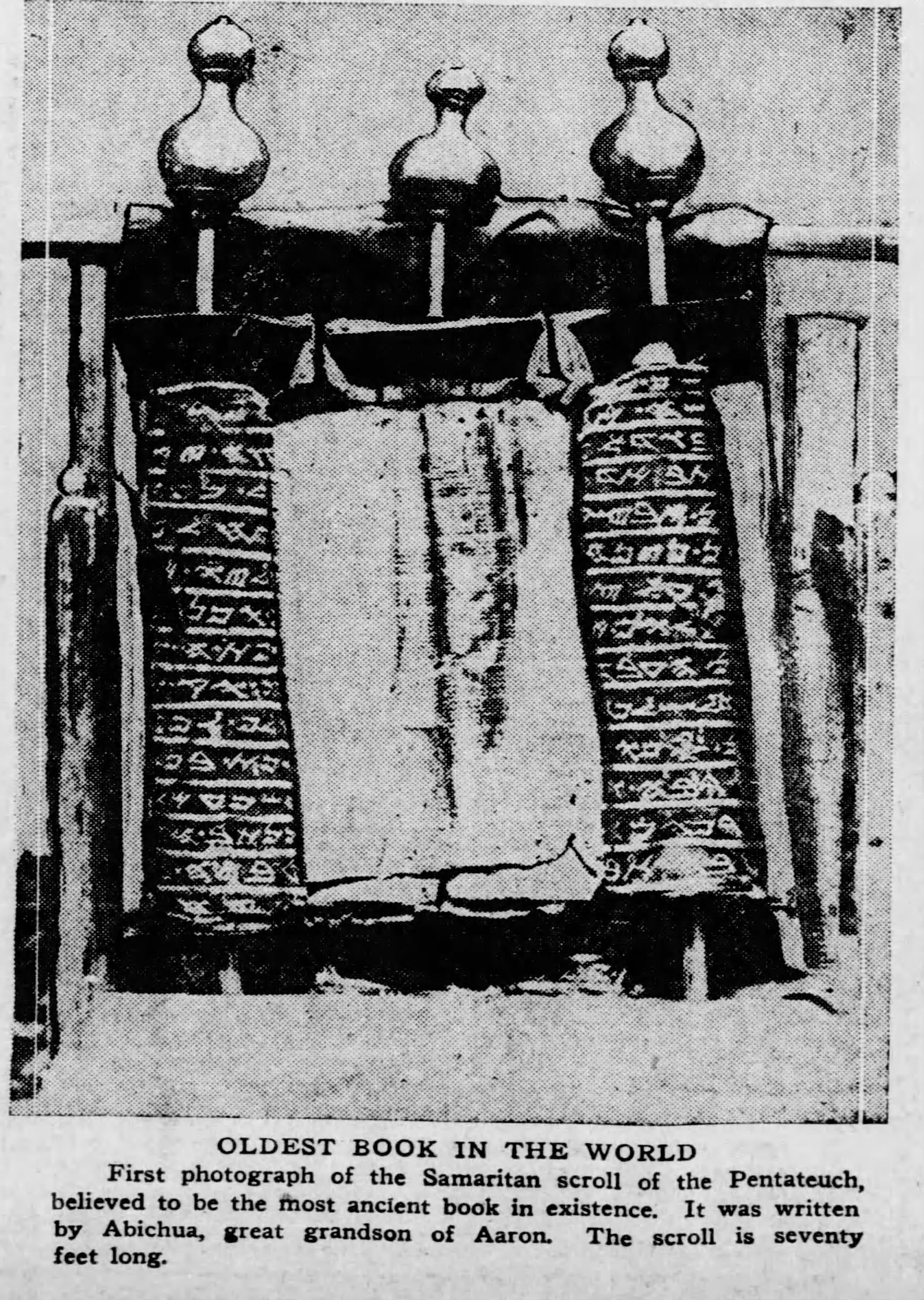
Also called Abisha Scroll, Samaritan Torah, SP.
Reflection
When Jesus spoke to the Samaritan woman at Jacob's well in John 4 and she said, "Our fathers worshiped on this mountain, but you say that in Jerusalem is the place where one ought to worship," she was not improvising. She was citing her Bible. The Samaritan Pentateuch — the only scripture the Samaritans accept — places the legitimate place of worship at Mount Gerizim, the mountain visible from the well where she stood. The Jewish Hebrew Bible places it at Jerusalem. The well-side conversation in John 4 is a textual conversation as much as a theological one.
The Samaritan community traces its origin to the northern kingdom of Israel after the Assyrian conquest in the 8th century BC. They preserved their own Pentateuch, written in their own script — a direct descendant of the paleo-Hebrew alphabet that the Jewish community abandoned in favor of the square Aramaic-derived script after the Babylonian Exile. The Samaritan Pentateuch differs from the Masoretic Hebrew Pentateuch in approximately 6,000 places, most of them minor — orthographic spellings, occasional harmonizations, and one major theological alteration: the Mount Gerizim addition to the Decalogue and to Deuteronomy.
What the Samaritan Pentateuch witnesses, despite its theological tendentiousness, is the textual stability of the Pentateuch itself. Two communities — the Jews and the Samaritans — split sometime around the 5th century BC, copied their separate texts independently for two and a half millennia, and arrived at the present with texts that agree in over 99% of substance. The Pentateuch was already so well-established by the time the communities divided that no amount of later copying could pull them seriously apart. In about 1,900 places, the Samaritan Pentateuch agrees with the Greek Septuagint against the Masoretic — suggesting it preserves some genuine readings that the Masoretic did not.
For the believer today, the Samaritan Pentateuch is a witness that even when Israel split into hostile communities, the Torah held them together at the textual level. The well at Sychar saw the meeting of two Pentateuchs and the One who fulfilled both. The Word stands.
Why this manuscript matters
- Samaritan textual tradition
- Independent witness to the Pentateuch
- Mount Gerizim variants