Public domain · via Wikimedia Commons ↗
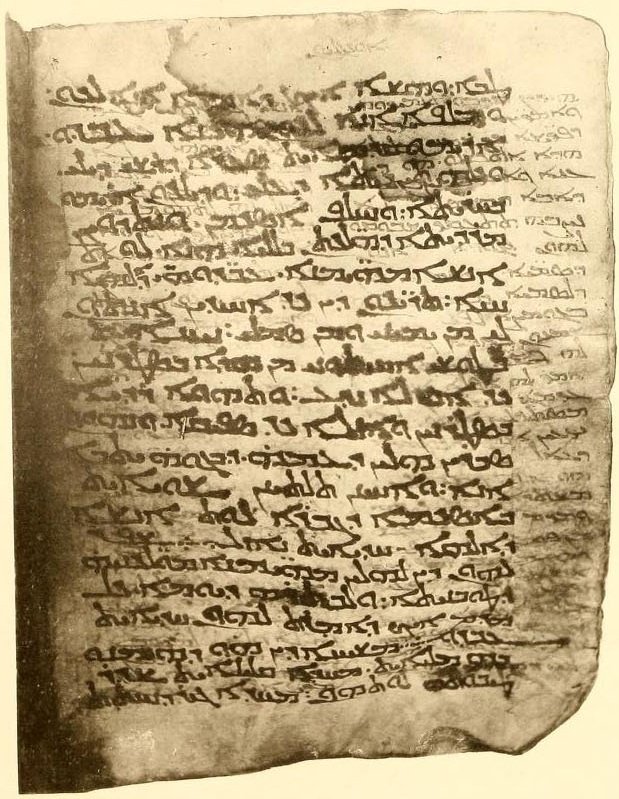
The Sinaitic Palimpsest
Also called Syrs, Old Syriac Sinaitic, Codex Sinaiticus Syriacus.
Reflection
On a February morning in 1892, two middle-aged Scottish Presbyterian women — twin sisters Agnes Smith Lewis and Margaret Dunlop Gibson — sat in the library of Saint Catherine's Monastery at the foot of Mount Sinai, examining a Syriac manuscript the monks had brought out for them. Agnes noticed something. The Syriac text on the page — biographies of female saints — was written over an older, fainter text. She turned the leaves carefully. Beneath the saints' lives, in 4th-century Syriac script, was a copy of the four gospels. They had found one of the oldest gospel manuscripts in any language.
The Sinaitic Palimpsest is older than every Old Latin gospel manuscript that survives. It is older than Codex Sinaiticus's Syriac sister text. It carries an Old Syriac translation of the four gospels — distinct from the later Peshitta, distinct from Tatian's Diatessaron, an independent witness to how the gospels were read in the Syriac-speaking churches in the century after Constantine. The text-type is Western with distinctive features. It opens, for example, with Matthew 1 — and the genealogy reads, "Joseph, to whom was betrothed Mary the virgin, begat Jesus." The phrasing has caused alarm, but the manuscript clarifies in the next breath that Mary was a virgin and that the child was conceived by the Holy Spirit. The translator was using the Semitic idiom of begetting in a way unfamiliar to Greek minds. The doctrine of the virgin birth is intact. The wording is a translation into the Syriac scribe's idiom of paternity.
The Smith-Lewis sisters returned to Cambridge with photographs. Their work transformed Syriac New Testament scholarship. In our own century, multispectral imaging has recovered text the sisters could not read.
For the believer today, the Sinaitic Palimpsest is a witness that even when men scrape off the gospel and write something else on top, the gospel is still there. Two Presbyterian women on holiday found it. The Word stands.
Why this manuscript matters
- Oldest Syriac gospel manuscript
- 4th-century Old Syriac text
- Smith Lewis / Dunlop Gibson discovery