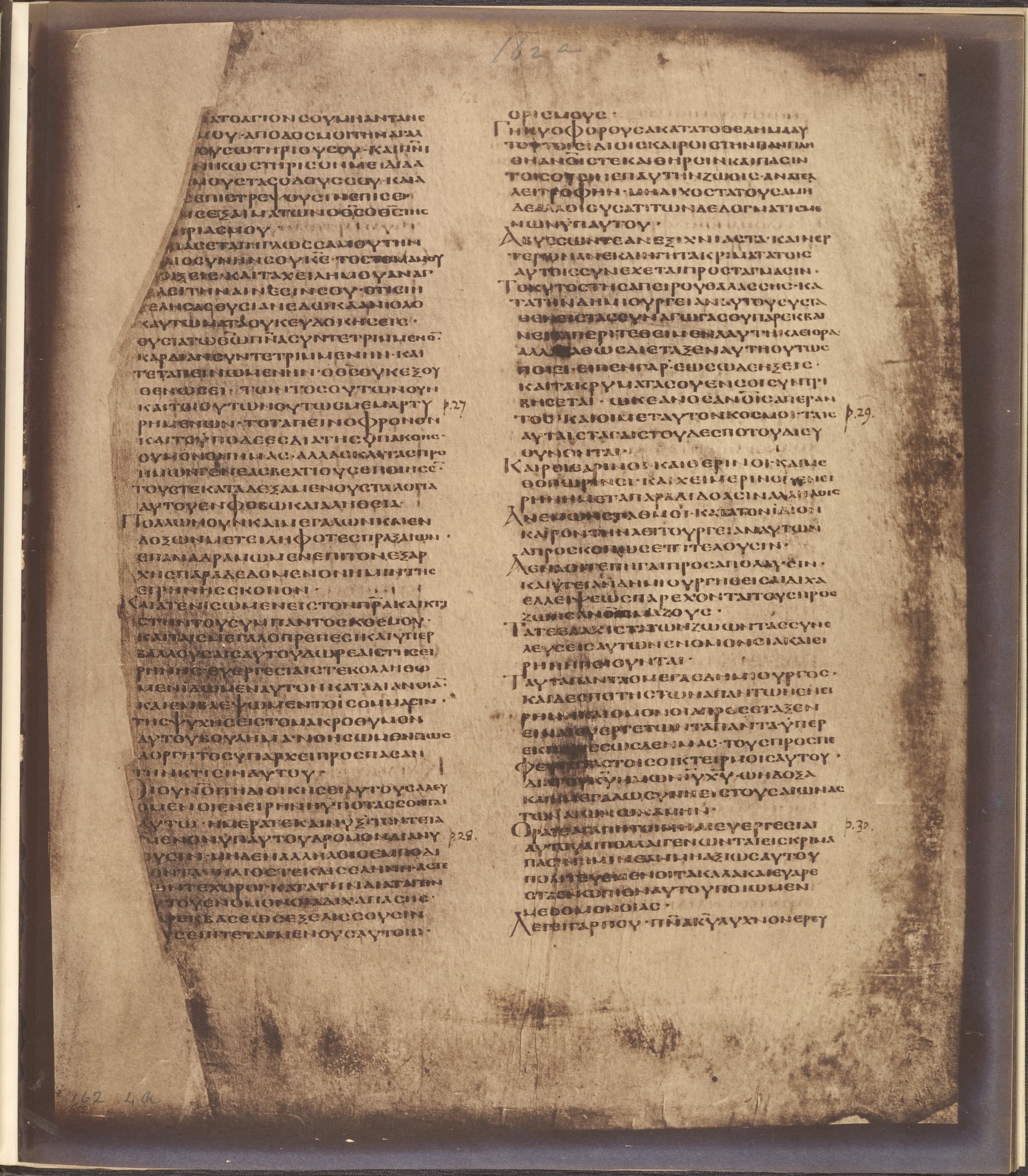
1 Clement is a long letter — sixty-five chapters in the modern division — sent from the church at Rome to the church at Corinth, traditionally attributed to Clement, named in early sources as the third bishop of Rome after Linus and Anacletus. Internal evidence dates it to roughly AD 95-96, near the end of Domitian's reign. The author writes in the name of the Roman congregation rather than as a personal correspondent; the letter never names Clement, and the attribution rests on the testimony of Hegesippus, Dionysius of Corinth, and Irenaeus. The letter addresses a leadership crisis: a faction at Corinth had deposed legitimate presbyters. Clement appeals to the Old Testament, to the example of Christ, and to the apostles — Peter and Paul are named as recent witnesses, with Paul's martyrdom referenced as common knowledge. The letter quotes 1 Corinthians by name, calling it Paul's epistle, and shows extensive knowledge of Hebrews. It is the earliest surviving Christian writing outside the New Testament canon. For early Christian history the letter is irreplaceable. It preserves the earliest external testimony to Peter and Paul's deaths in Rome, the earliest non-canonical reference to a New Testament book by name, and the earliest non-canonical statement of apostolic succession. Some early communities — Egypt and Syria especially — read 1 Clement liturgically; Codex Alexandrinus binds it after Revelation. By the late 4th century it was firmly outside the canon but still venerated. Its complete Greek text was rediscovered in 1873 in the same Bryennios manuscript that preserved the Didache. Sources: J. B. Lightfoot, The Apostolic Fathers, Part I: S. Clement of Rome (1890); Bart Ehrman, ed., The Apostolic Fathers, vol. 1 (Loeb, 2003); Andrew Gregory, "1 Clement and the Writings That Later Formed the New Testament," in The Reception of the New Testament in the Apostolic Fathers (2005); Larry Welborn, "On the Date of First Clement," Biblical Research 29 (1984).
Demonstrates that Pauline writings were already authoritative and recognized as scripture in churches Paul founded by the end of the 1st century. The earliest example of one church writing pastorally to another in the apostolic mode.