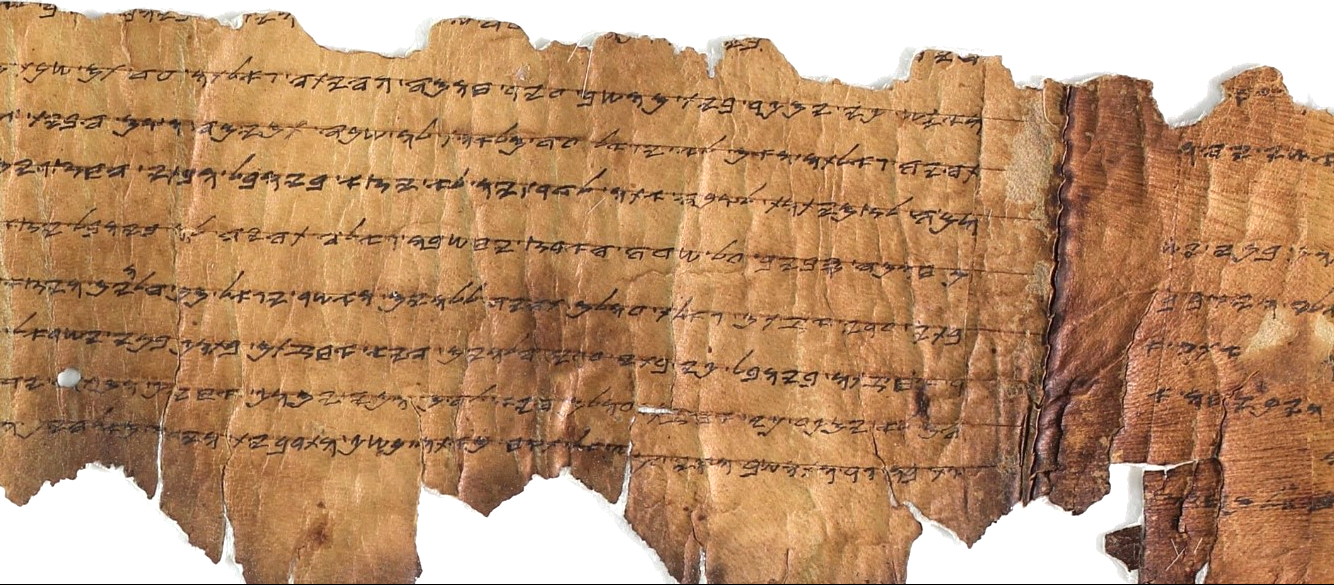
11QPaleoLeviticus (formally designated 11Q1) was recovered from Cave 11 at Qumran, near the northwestern shore of the Dead Sea, in 1956, the same season that yielded the Temple Scroll and other significant finds. The cave was excavated under the auspices of the École Biblique et Archéologique Française and the Palestine Archaeological Museum. The scroll fragments were subsequently entrusted to the Israel Antiquities Authority and are now housed principally at the Shrine of the Book within the Israel Museum in Jerusalem. The critical edition was prepared by David Noel Freedman and K. A. Mathews and published in 1985 as part of the American Schools of Oriental Research monograph series. The manuscript is written on leather in paleo-Hebrew script — the angular, lapidary letterform derived from the Phoenician alphabet used in Israel before the Babylonian exile — rather than the square Aramaic script standard in most Dead Sea Scrolls. Paleographic analysis dates the hand to approximately the first century BC. The preserved columns contain substantial portions of Leviticus, including sections from chapters 4, 10–11, 13–14, 19–23, and 27, covering purity regulations, the sacrificial cult, dietary laws, and the holiness code. Orthographic and textual analysis shows the manuscript aligns closely with the proto-Masoretic tradition, exhibiting few divergences from the later received Hebrew text. The scroll's use of paleo-Hebrew for a Torah text reflects a scribal convention attested at Qumran in which certain authoritative Pentateuchal books were copied in archaic script, possibly to signal their foundational status or antiquity. This practice contextualizes Second Temple attitudes toward scriptural authority and textual preservation. The manuscript's close agreement with the Masoretic text of Leviticus supports the view that Leviticus was transmitted with considerable fidelity across several centuries, providing a significant data point for text-critical study of the Pentateuch. **Sources:** David Noel Freedman and K. A. Mathews, *The Paleo-Hebrew Leviticus Scroll (11QpaleoLev)* (American Schools of Oriental Research, 1985); Emanuel Tov, *Textual Criticism of the Hebrew Bible*, 3rd ed. (Fortress Press, 2012); Frank Moore Cross, *The Ancient Library of Qumran*, 3rd ed. (Fortress Press, 1995); Leviticus 1–27.
11QPaleoLeviticus demonstrates that archaic paleo-Hebrew script remained in deliberate liturgical use for Torah texts at Qumran, providing direct manuscript evidence for the transmission history and textual stability of Leviticus across the late Second Temple period.