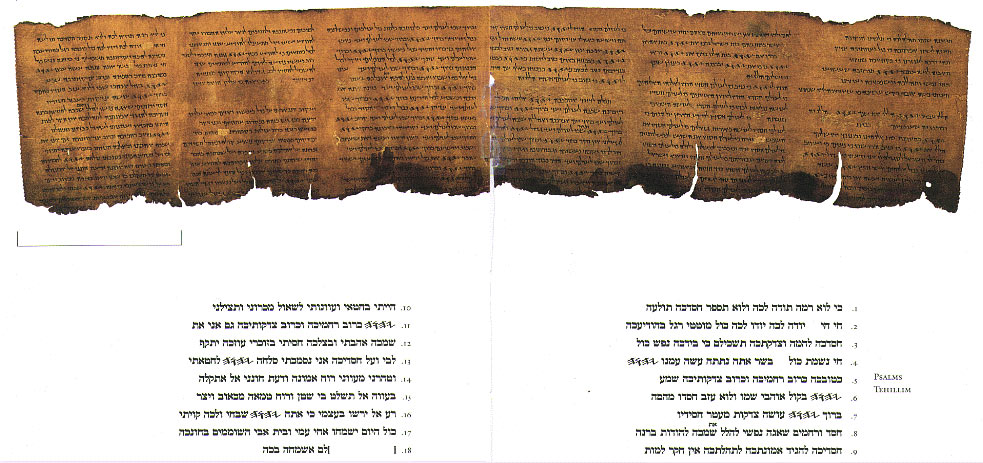
Discovered in 1956 by Bedouin excavators in Cave 11 at Khirbet Qumran, near the northwest shore of the Dead Sea, the Great Psalms Scroll was subsequently purchased and studied by scholars working under the auspices of the Palestine Archaeological Museum (later the Rockefeller Museum). James A. Sanders published the editio princeps in 1965 as volume IV of the Discoveries in the Judaean Desert series. The scroll is now housed at the Shrine of the Book within the Israel Museum, Jerusalem, under Israel Antiquities Authority stewardship. The manuscript is written on leather in a formal Herodian square script, paleographically dated to the first half of the first century AD, though the textual tradition it transmits is considerably older. In its reconstructed form the scroll measures approximately 4.4 meters in length and contains 49 compositions across 28 surviving columns. These include 41 canonical psalms from Books IV and V of the Masoretic Psalter, presented in a sequence that diverges significantly from the received Hebrew Bible order. The scroll also incorporates non-canonical compositions, among them the prose catalogue known as David's Compositions, which attributes 4,050 songs to David, and the apocryphal Psalm 151, previously known only through the Greek Septuagint. The canonical text of 2 Samuel 23:1–7 also appears. The scroll's divergent psalm order has generated sustained scholarly debate regarding whether it represents a liturgical anthology or a genuine alternative scriptural edition of the Psalter. Scholars including Peter Flint have argued that the manuscript reflects a genuinely fluid canonical situation for Psalms 90–150 in Second Temple communities, indicating that the final shape of the Psalter was not yet fixed during the scroll's period of use. This evidence is central to broader discussions of scriptural canonization processes in early Judaism. **Sources:** James A. Sanders, *The Psalms Scroll of Qumrân Cave 11* (Clarendon Press, 1965); Peter W. Flint, *The Dead Sea Psalms Scrolls and the Book of Psalms* (Brill, 1997); Eugene Ulrich, *The Dead Sea Scrolls and the Origins of the Bible* (Eerdmans, 1999); Psalms 101–150; 2 Samuel 23:1–7.
11QPsa preserves the largest and most textually complex Psalms manuscript from Qumran, documenting a psalmic arrangement divergent from the Masoretic tradition and illuminating the open-ended canonical status of the Psalter in late Second Temple Judaism.