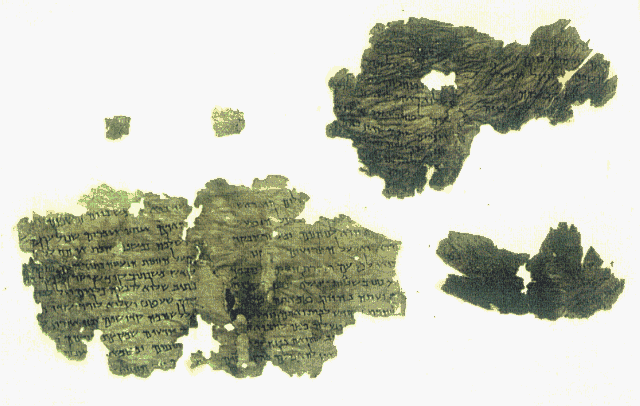
Fragments now designated 4QMMT (Miqsat Ma'ase ha-Torah, 'Some Rulings Pertaining to the Torah') were recovered from Qumran Cave 4 beginning in 1952 during excavations organized under Roland de Vaux and the École Biblique et Archéologique Française. The document is reconstructed from six overlapping manuscripts (4Q394–4Q399), first published in preliminary form by Elisha Qimron and John Strugnell, with the editio princeps appearing in Discoveries in the Judaean Desert X (Oxford, 1994). The fragments are held by the Israel Antiquities Authority, with selected pieces displayed at the Shrine of the Book, Jerusalem. The composite text spans three sections: a liturgical calendar, a central halakhic catalogue enumerating roughly twenty legal positions, and an epistolary conclusion addressed to a leader identified only as 'you.' Written primarily on parchment in a Herodian or early Hasmonean scribal hand, the document measures only a few centimeters in preserved width across individual fragments, yet the reconstructed text runs to approximately 130 lines. The legal rulings address purity matters including the transfer of impurity through liquids (the 'niqqur' issue), Gentile grain offerings, marriage regulations, and temple-entry restrictions—areas where the document's authors diverge from practices associated with opponents, widely identified by scholars as proto-Pharisaic circles. The text references categories codified in Leviticus and Numbers and invokes Deuteronomic judicial authority. For biblical studies, 4QMMT is significant on two levels. First, it documents the diversity of Torah interpretation within late Second Temple Judaism, demonstrating that legal rulings now visible only in rabbinic literature were actively contested centuries earlier. Second, the phrase ma'ase ha-torah ('works of the law') appearing in the document's conclusion has become central to scholarly analysis of the identical Greek idiom erga nomou in Pauline letters, situating that New Testament debate within a verifiable contemporary legal context rather than treating it as purely theological abstraction. **Sources:** Elisha Qimron and John Strugnell, *Qumran Cave 4, Vol. V: Miqsat Ma'ase Ha-Torah*, Discoveries in the Judaean Desert X (Clarendon Press, 1994); Martin Abegg Jr., 'Paul, 'Works of the Law' and MMT,' *Biblical Archaeology Review* 20.6 (1994); James D.G. Dunn, *The Theology of Paul the Apostle* (Eerdmans, 1998); Deuteronomy 17:8-13; Galatians 2:16.
4QMMT provides direct epigraphic evidence of intra-Jewish legal dispute in the late Second Temple period and supplies a likely sectarian context for the phrase 'works of the law' debated in Pauline scholarship, grounding the New Testament idiom in demonstrable halakhic discourse.