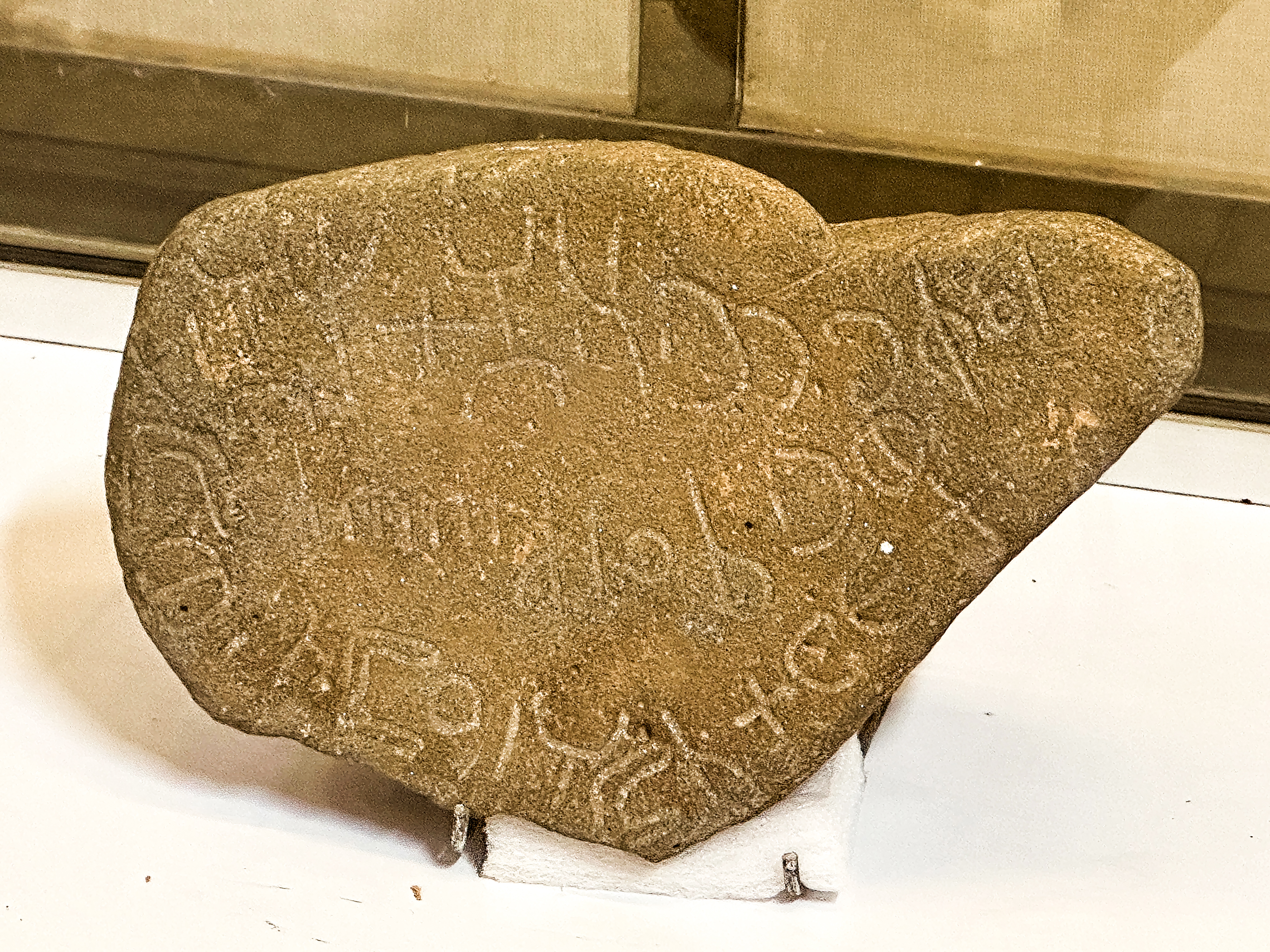
The Adoni-Nur seal impression came to scholarly attention through the antiquities market in the mid-twentieth century and was subsequently acquired by the Israel Museum, Jerusalem, where it is held within the Israel Antiquities Authority collection. Its exact archaeological provenience is unrecorded, as it surfaced outside a controlled excavation context, a circumstance common to many Iron Age II seals. Epigraphic and paleographic analysis, conducted most rigorously by Nahman Avigad, places the seal in the seventh century BC on the basis of its Ammonite script style. The seal is a small, ovoid, engraved stone bearing a two-line Hebrew-Ammonite inscription reading: "Belonging to Adoni-Nur, servant of Ammi-Nadab." The title "servant" (Heb. ʿeved) in this context denotes a senior royal official or steward rather than a domestic slave, a well-documented usage in Northwest Semitic administrative epigraphy. The personal name Ammi-Nadab corresponds to an Ammonite king attested in Assyrian annals of Esarhaddon and Ashurbanipal (circa 678–667 BC), lending chronological precision. The seal's iconographic register includes a winged sphinx or griffon motif, consistent with Ammonite glyptic art of the period. For biblical scholarship, the seal illuminates the administrative and royal apparatus of Ammon, the Transjordanian kingdom that appears repeatedly in the Hebrew Bible as a neighbor and frequent antagonist of Israel. Passages in 2 Samuel, Jeremiah, and Amos presuppose an organized Ammonite monarchy with named rulers and court functionaries; the Adoni-Nur bulla provides direct epigraphic evidence for precisely such an institution. The corroboration of the royal name Ammi-Nadab through both Assyrian records and this seal exemplifies how Northwest Semitic glyptic epigraphy can triangulate biblical and extra-biblical sources. The seal remains a central reference point in studies of Ammonite political culture and Iron Age Levantine administration. **Sources:** Nahman Avigad and Benjamin Sass, *Corpus of West Semitic Stamp Seals* (Israel Academy of Sciences and Humanities, 1997); K. A. D. Smelik, *Writings from Ancient Israel* (Westminster John Knox, 1991); Walter E. Aufrecht, *A Corpus of Ammonite Inscriptions* (Edwin Mellen Press, 1989); 2 Samuel 10:1-2; Jeremiah 49:1-6.
This Ammonite bulla independently attests a royal name—Ammi-Nadab—known from Iron Age epigraphy and situates a titled royal steward within Ammonite administrative hierarchy, directly illuminating the bureaucratic world behind biblical references to Ammon's monarchy.