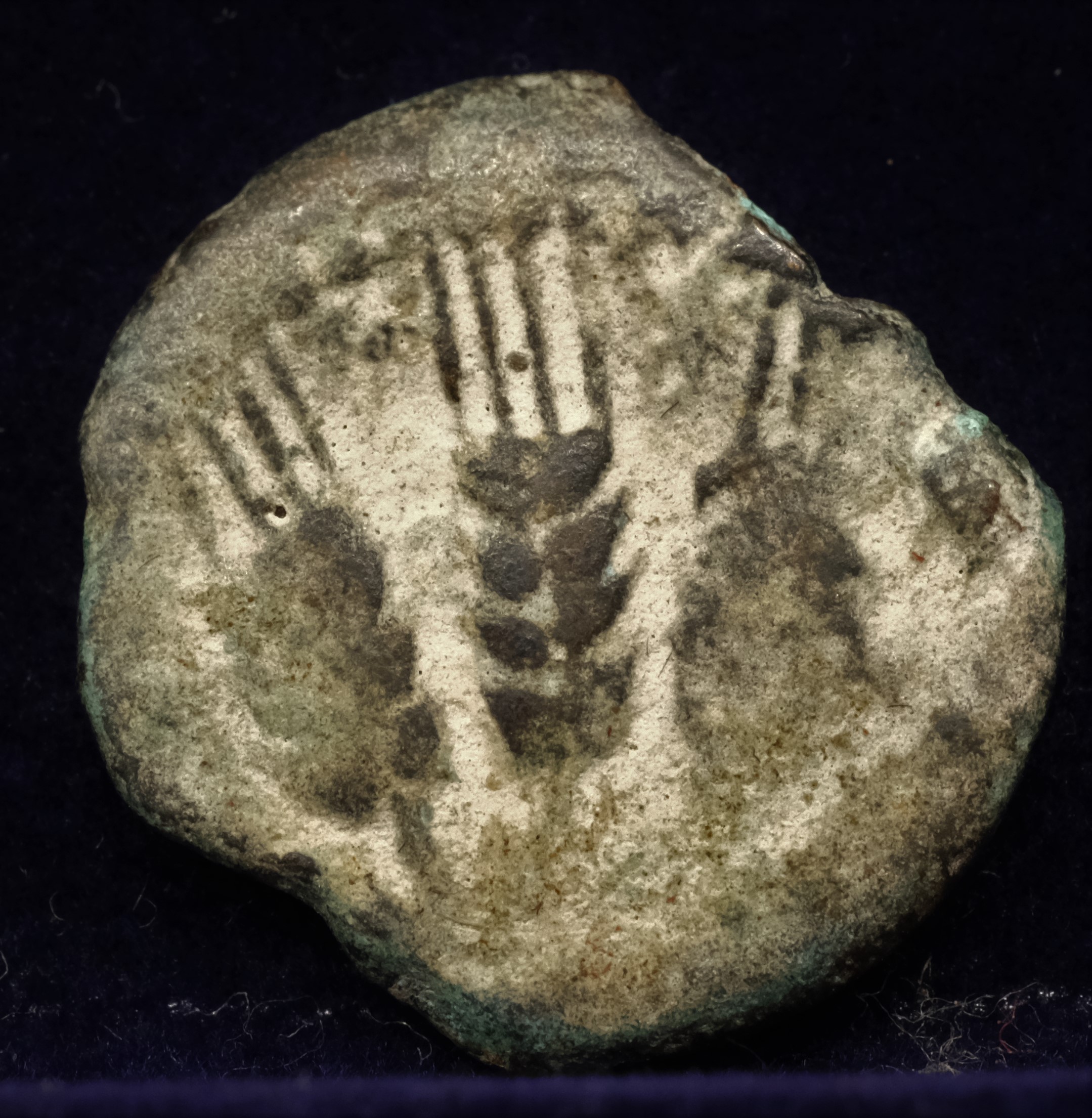
Bronze coins attributable to Marcus Julius Agrippa II—son of Agrippa I and great-grandson of Herod the Great—have been recovered from excavations at Caesarea Maritima, Gamla, and numerous Galilean and Transjordanian sites. Systematic numismatic classification was advanced by Ya'akov Meshorer in the late twentieth century, with his corpus published through the Israel Exploration Society. Significant holdings reside in the Kadman Numismatic Pavilion of the Israel Museum (Jerusalem), the British Museum's Department of Coins and Medals, and the American Numismatic Society collection in New York. The series spans roughly AD 50–95, issued in Agrippa's administrative capital Caesarea Philippi (renamed Neronias and later Panias). The bronzes are typically small to medium module prutot and larger denominations, struck in copper alloy. Obverse types feature portraits or titulatures of successive emperors—Claudius, Nero, Vespasian, Titus, and Domitian—while reverses display royal monograms, anchors, and occasional dedications referencing Agrippa's loyalty to Rome. Many coins bear regnal year dates counted from AD 56 or from Agrippa's receipt of expanded territories, allowing precise chronological anchoring. Meshorer catalogued these issues as Series 18–22 in his standard typology. For biblical study, these bronzes directly contextualize the Acts 25–26 account in which Agrippa II and Berenice arrive at Caesarea to hear Paul's defense before the procurator Festus. The coinage confirms Agrippa's status as a functioning client king under Flavian patronage well into the period when Luke's narrative closes, corroborating the historical plausibility of the Acts account. The sustained imperial portrait types also illustrate the deep entanglement of Herodian political identity with Roman imperial ideology, a social reality that pervades the backdrop of Pauline mission territory. The series remains the primary numismatic dataset for reconstructing late Herodian governance. **Sources:** Ya'akov Meshorer, *A Treasury of Jewish Coins from the Persian Period to Bar Kokhba* (Amphora Books / Israel Exploration Society, 2001); David Hendin, *Guide to Biblical Coins*, 5th ed. (Amphora Books, 2010); Fabian Udoh, *To Caesar What Is Caesar's: Tribute, Taxes, and Imperial Administration in Early Roman Palestine* (Brown Judaic Studies, 2005); Acts 25:13–26:32.
Agrippa II is the only Herodian ruler named in the Acts narrative to have a dateable coinage series, placing Paul's Caesarean hearing within a precisely documented political framework and illuminating Roman-client kingship in the late Second Temple period.