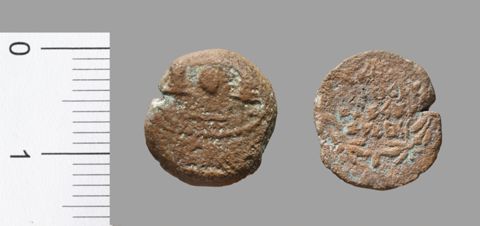
The bronze prutah of Alexander Jannaeus is among the most abundantly attested coins from ancient Judaea, struck at Jerusalem between approximately 103 and 76 BC during the reign of the Hasmonean king-priest. Cast or struck in low-denomination bronze, individual specimens weigh roughly 1–2 grams. The obverse typically carries an eight-pointed star or anchor motif accompanied by a Greek legend reading 'ALEXANDROU BASILEOS' ('of King Alexander'), while the reverse displays a wheel or anchor with a Paleo-Hebrew or Aramaic inscription identifying the king. Their extreme commonality in the archaeological record—appearing across Judaean, Galilean, and Transjordanian sites—reflects widespread everyday circulation across a century or more after their initial issue, meaning they were still in active use well into the first century AD. This longevity of circulation is directly relevant to Mark 12:41–44 and Luke 21:1–4, where Jesus observes a poor widow depositing two 'lepta' (the Greek term for the smallest denomination coins) in the Temple treasury. The Jannaeus prutah, which is itself a lepton in the monetary hierarchy of Roman-period Judaea, is the coin most frequently proposed by numismatists to satisfy this description, though the identification cannot be made with certainty on textual grounds alone. What the material record does confirm is that such coins were the practical currency of the poor in first-century Judaea, consistent with the Gospel narrative's social setting. The Yale University Art Gallery example (inv. 1938.6000.1874) is representative of the type. Sources: Yale University Art Gallery collection records; Ya'akov Meshorer, 'A Treasury of Jewish Coins' (2001); Hendin, 'Guide to Biblical Coins' (5th ed., 2010); Israel Exploration Journal.
The Jannaeus prutah provides direct numismatic context for the 'widow's mite' episode, demonstrating that sub-denarius bronze coinage was in broad popular circulation throughout Judaea well into the first century AD. Its extraordinary archaeological frequency attests the economic realities of the Judaean poor during the Second Temple period.