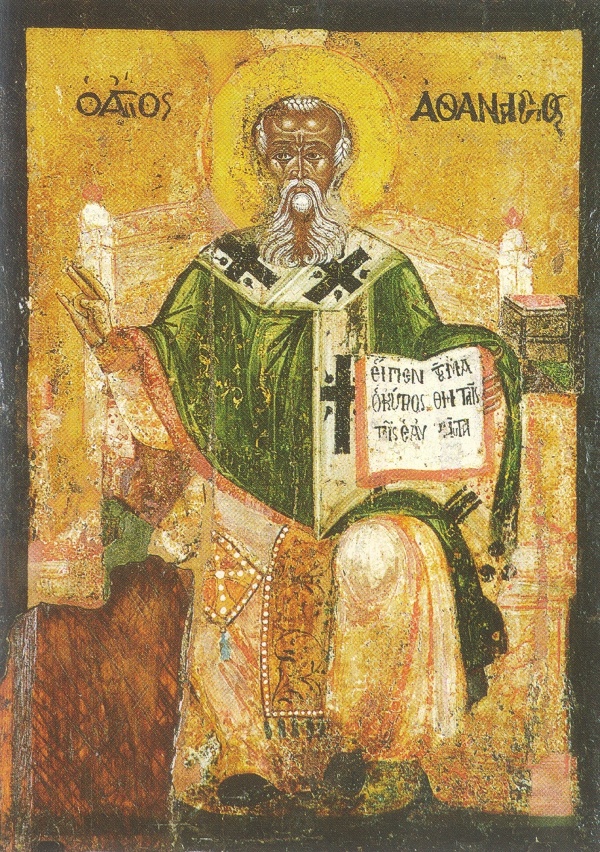
Athanasius of Alexandria served as bishop of that city for forty-five years (328-373), through five exiles imposed for his unyielding defense of Nicene Christology. The annual Festal Letter, sent from the patriarch of Alexandria to the Egyptian and Libyan churches each Epiphany, announced the coming dates of Lent and Easter and addressed pastoral matters of the year. The 39th Festal Letter, issued at Easter 367, breaks from routine to address a question that had grown urgent: which books are scripture, and which are not. Athanasius lists the twenty-two books of the Old Testament (according to the Hebrew enumeration, which combines several books) and then enumerates the twenty-seven books of the New Testament — the four Gospels, Acts, the seven Catholic Epistles (James, 1-2 Peter, 1-2-3 John, Jude), the fourteen Pauline letters including Hebrews, and Revelation — in the order and identity used today. He continues: "These are the springs of salvation, that he who thirsts may be satisfied with the words contained in them. In these alone the doctrine of godliness is proclaimed. Let no one add to them, nor take anything from them." He distinguishes a second class of books "appointed by the Fathers to be read by those who newly join us and want instruction in the doctrine of piety": the Wisdom of Solomon, Sirach, Esther, Judith, Tobit, the Didache, and the Shepherd of Hermas. This is the first surviving list of the New Testament canon exactly as later Christian tradition received it. The Greek original survives in fragments; the fullest text is Coptic. The Council of Carthage in 397 made the same enumeration binding for the Latin West. Sources: Athanasius, Festal Letter 39 (PG 26; trans. NPNF 2.4); David Brakke, "Canon Formation and Social Conflict in Fourth-Century Egypt," HTR 87 (1994); Bruce Metzger, The Canon of the New Testament (1987); Lee Martin McDonald, The Biblical Canon (3rd ed., 2007).
The first complete, named list of the 27-book New Testament canon. Settles questions about which books the early church considered scripture. The letter reflects a consensus that had been forming for centuries; it didn't create the canon, it ratified it.