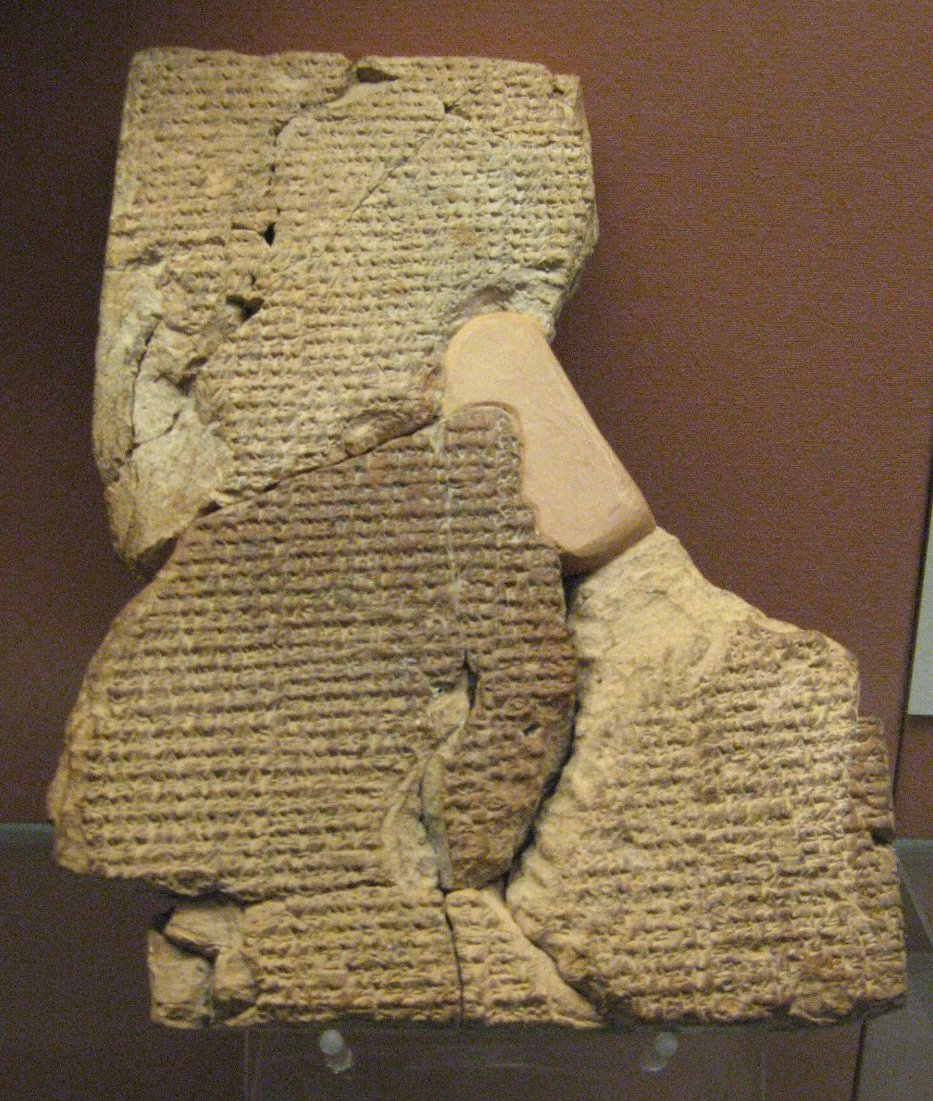
The Atrahasis Epic is known primarily from a cuneiform tablet set first assembled by Assyriologist George Smith in the 1870s from tablets held at the British Museum, though the critical edition was established by W. G. Lambert and A. R. Millard in their 1969 publication. The principal Old Babylonian tablets (catalogued under BM 78941 and related pieces) date to approximately 1700 BC, though the composition likely circulated in earlier oral and written forms. Additional fragments were identified across excavations at Nippur, Ur, and Nineveh, with some held at the Vorderasiatisches Museum in Berlin and the University of Pennsylvania Museum of Archaeology and Anthropology (Philadelphia). The epic is written in Akkadian cuneiform across three tablets and spans roughly 1,245 lines in its most complete reconstruction. It narrates the creation of humanity from clay mixed with divine blood to relieve the lesser gods of labor, followed by successive divine attempts to reduce overpopulation through plague, drought, and finally a catastrophic flood. The flood hero Atrahasis is warned by the god Enki, constructs a vessel, survives the deluge, and offers sacrifice upon landing — structural and thematic elements that parallel Genesis 6–9 closely, including divine regret, a chosen survivor, sealed vessel construction, and post-flood covenant. The creation section similarly resonates with Genesis 1–2 in its depiction of the fashioning of human beings from earth and a divine substance. For biblical scholarship, the Atrahasis Epic demonstrates that the Genesis flood and creation narratives share a common ancient Near Eastern literary heritage without requiring direct textual dependence. The parallels illuminate how the biblical authors engaged, adapted, and theologically reoriented existing cosmological traditions — particularly in Genesis's monotheistic framing and its covenant theology — distinguishing the Hebrew text within, rather than apart from, its broader cultural context. **Sources:** W. G. Lambert and A. R. Millard, *Atra-Hasis: The Babylonian Story of the Flood* (Oxford University Press, 1969); Stephanie Dalley, *Myths from Mesopotamia* (Oxford University Press, 1989); John H. Walton, *Ancient Near Eastern Thought and the Old Testament* (Baker Academic, 2006); Genesis 6:1–9:17.
The Atrahasis Epic, composed in Akkadian no later than the early second millennium BC, provides the most complete pre-biblical parallel to the Genesis flood and human creation accounts, anchoring those narratives within a broader ancient Near Eastern literary tradition.