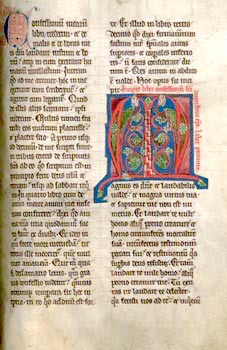
Augustine of Hippo (354-430), bishop of the North African coastal city of Hippo Regius (modern Annaba in Algeria), composed the Confessions between roughly 397 and 401, a few years after his consecration as bishop. The work is the first sustained Western autobiography — an extended prayer in thirteen books, addressed throughout to God in the second person, tracing Augustine's life from infancy through his mother Monica's death at Ostia and concluding with three books of meditation on memory, time, and Genesis 1. Augustine drafted the Confessions in his late forties; he had been a Christian for thirteen years. The manuscript tradition begins almost immediately. The earliest surviving copies are 5th- and 6th-century, produced in monastic scriptoria across the post-Roman West — fragments from southern Italy, complete copies from Bobbio and Lyon. The 6th-century Codex Sessorianus 55 (Rome, Biblioteca Nazionale) is the oldest substantial witness. Carolingian copying multiplied the text in the 8th and 9th centuries; the standard medieval edition descends from those exemplars. Pierre de Labriolle's 1925 critical edition and James J. O'Donnell's 1992 Oxford edition are the modern standards. The Confessions transformed Western literary and theological tradition. The interior monologue addressed to God; the careful introspective examination of memory, motive, and the divided will; the use of personal narrative as theological argument — all shaped subsequent autobiography from Petrarch through Rousseau, and modern Christian devotional writing through Bunyan and Newman. In Book 8, Augustine recounts the decisive moment in the garden at Milan in 386, when he heard a child's voice chanting "Tolle lege, tolle lege" — "Take up and read, take up and read" — opened Paul's letter to the Romans, and read 13:13-14. The Confessions is the most frequently copied Latin work of the Middle Ages after the Bible. Sources: Peter Brown, Augustine of Hippo: A Biography (rev. ed. 2000); James J. O'Donnell, Augustine: Confessions (3-vol. ed. 1992); Pierre Courcelle, Recherches sur les Confessions de Saint Augustin (1950); Henry Chadwick, Saint Augustine: Confessions (Oxford World's Classics, 1991).
A direct window into the inner life of the most influential theologian of the Latin church. Augustine's analyses of memory, time, sin, grace, and human longing structured Western Christian thought for 1,500 years.