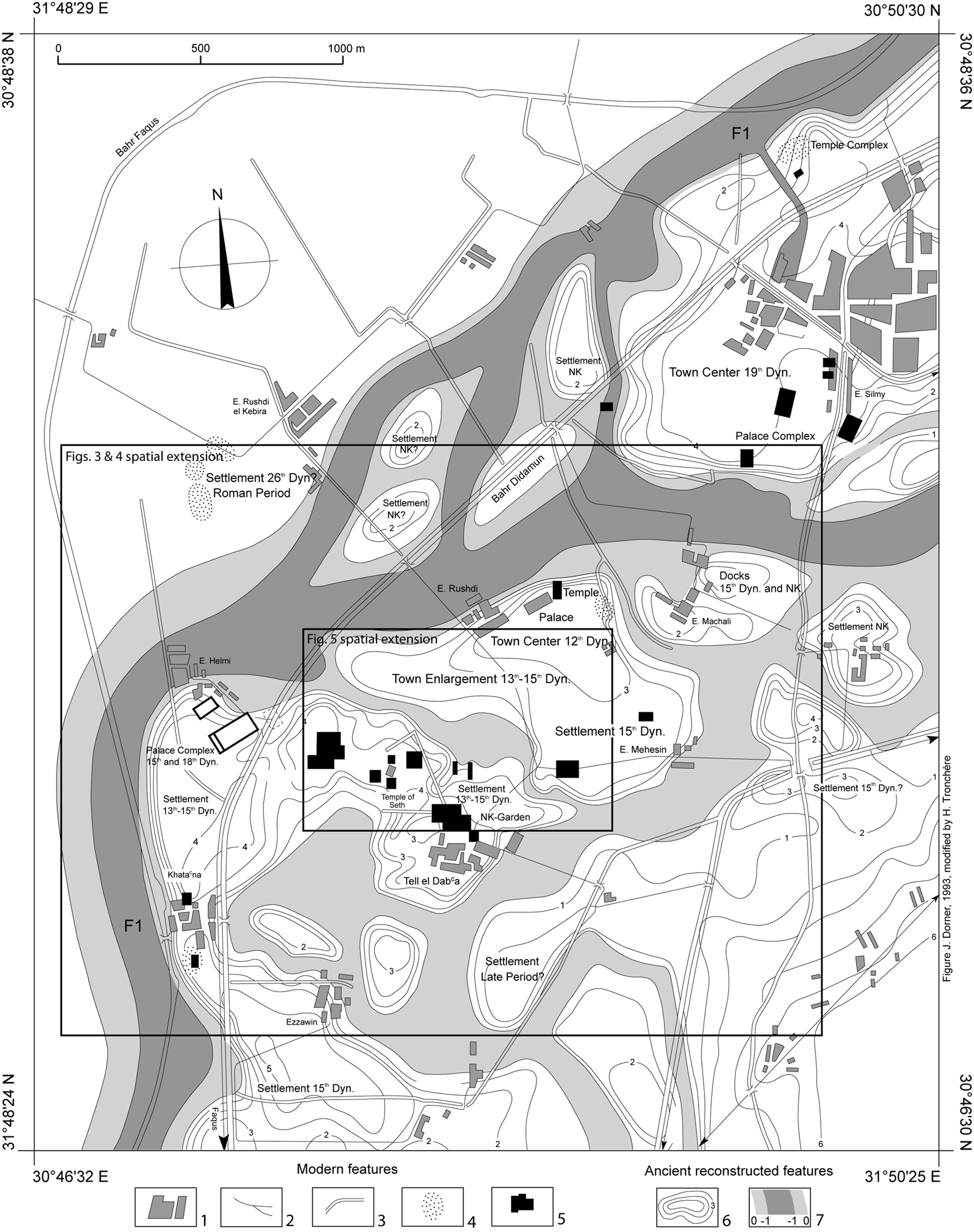
Systematic excavation at Tell el-Daba, located in the northeastern Nile Delta near modern Faqus, began under Manfred Bietak of the Austrian Archaeological Institute in 1966 and has continued with interruptions into the early twenty-first century. The site was identified with ancient Avaris, the Hyksos capital, through converging epigraphic and stratigraphic evidence accumulated over decades of fieldwork. Finds are primarily held in situ or within the Egyptian Museum, Cairo, with documentation maintained through the Austrian Archaeological Institute's ongoing publication series. Excavation has revealed a stratigraphic sequence spanning roughly 1800–1550 BC, encompassing the late Middle Kingdom, Second Intermediate Period, and early New Kingdom. Among the most significant finds are mud-brick domestic structures conforming to Syrian-Canaanite architectural typology rather than indigenous Egyptian forms, along with pottery assemblages closely paralleling Middle Bronze Age Levantine wares. A painted fresco fragment recovered from stratum d/1 (mid-sixteenth century BC) displays a Minoan-style acrobatic bull-leaping scene, suggesting international contact. Burial patterns, including interments beneath house floors with toggle-pin and scarab grave goods characteristic of Syro-Palestinian populations, indicate a large, settled Semitic community. The site's ancient toponym connects it to the biblical land of Goshen (Genesis 47:11) and has been associated by many scholars with the city of Ramesses mentioned in Exodus 1:11, though the precise identification remains debated at the level of specific textual equations. For biblical study, Tell el-Daba provides the most substantial archaeological context currently available for evaluating the plausibility of a Semitic population residing in the Egyptian eastern Delta during the late Middle Bronze Age. The site demonstrates that sustained Asiatic settlement in this region was historically feasible, offering material grounding for the Genesis and Exodus narratives without adjudicating their precise historicity. The bull-leaping fresco and Aegean contact evidence further illuminate Egypt's broader Mediterranean connections during this period. **Sources:** Manfred Bietak, *Avaris: The Capital of the Hyksos* (British Museum Press, 1996); Manfred Bietak, Ernst Czerny, et al., *The Bronze Age in the Lebanon* and Tell el-Daba series, *Untersuchungen der Zweigstelle Kairo* (Austrian Academy of Sciences Press, 1975–2010); James K. Hoffmeier, *Israel in Egypt* (Oxford University Press, 1997); Genesis 47:11; Exodus 1:11.
Tell el-Daba preserves stratigraphic and material evidence of a substantial Semitic population in Egypt's eastern Delta during the Middle Bronze Age, directly contextualizing biblical references to Israelite settlement in the region of Goshen and the city of Ramesses.