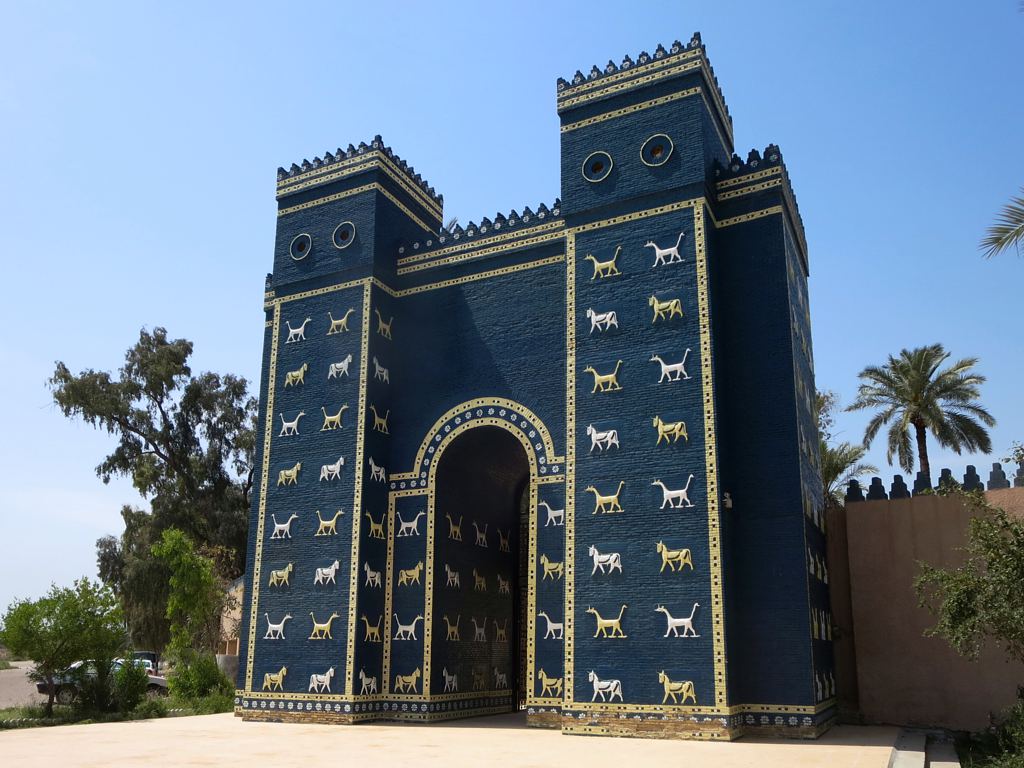
Babylon stretches along the Euphrates roughly ninety kilometers south of Baghdad, on a plain that has been continuously occupied since the third millennium BC. Robert Koldewey directed the Deutsche Orient-Gesellschaft expedition there from 1899 to 1917 — eighteen continuous seasons that produced the first scientific stratigraphy of a Mesopotamian capital and the first reconstruction of the Neo-Babylonian city as Nebuchadnezzar II rebuilt it between 605 and 562 BC. Koldewey traced the inner and outer walls (the inner some eight kilometers in circuit), the Processional Way, the foundation of Etemenanki — the seven-stage ziggurat of Marduk that the Genesis 11 Tower of Babel tradition reflects — the Marduk temple complex, and the Northern, Southern, and Summer palaces of Nebuchadnezzar. The Ishtar Gate, the northern entrance to the inner city, was disassembled brick by brick and shipped to Berlin between 1902 and 1914; it was reconstructed at the Vorderasiatisches Museum in 1930 and remains on permanent display there — 575 glazed-brick reliefs of Marduk's mušḫuššu dragons and Adad's bulls. The Hanging Gardens described by Hellenistic authors have not been securely identified on the ground; their existence at Babylon is genuinely disputed in current scholarship, with Stephanie Dalley arguing they belonged at Sennacherib's Nineveh. Babylon is the city of the Captivity. 2 Kings 24–25 records Nebuchadnezzar's two deportations of Judah in 597 and 586 BC; Daniel 1 places the prophet and his three companions in the royal court; Daniel 5 narrates Belshazzar's feast and the writing on the wall on the night Babylon fell to the Medo-Persian forces in 539 BC. Psalm 137 — "By the rivers of Babylon, there we sat down and wept" — is the captives' lament from these decades. The site was partially restored under Saddam Hussein in the 1980s and damaged again by US-led occupation forces between 2003 and 2009. Babylon was inscribed as a UNESCO World Heritage Site in 2019. Sources: Robert Koldewey, Das wieder erstehende Babylon (Hinrichs, 1913) / Excavations at Babylon (Macmillan, 1914); Joan Oates, Babylon (Thames and Hudson, 1986); Stephanie Dalley, The Mystery of the Hanging Garden of Babylon (Oxford, 2013); Daniel 1–5; Jeremiah 51.
Babylon provides the most extensively excavated context for the Neo-Babylonian empire that deported Judah in 597 and 586 BC, anchoring the biblical narratives of the Captivity, Daniel's court, and Belshazzar's fall within a stratigraphically documented capital whose monumental architecture Koldewey's eighteen seasons systematically recovered.