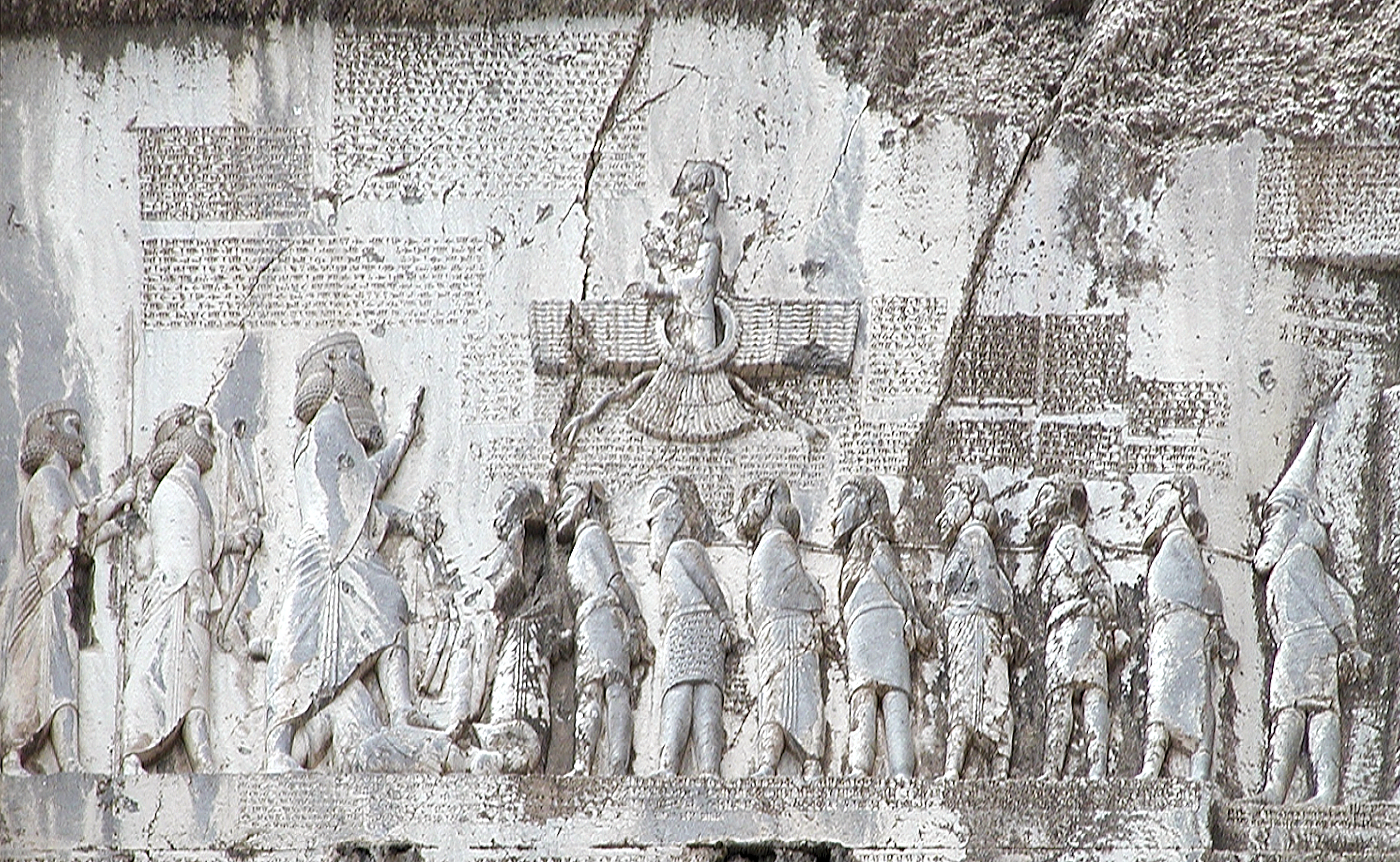
The Behistun Inscription was carved into a limestone cliff approximately 100 meters above the ancient road connecting Babylon to Ecbatana, in what is now Kermanshah Province, Iran, on the order of the Achaemenid king Darius I (r. 522–486 BC). The inscription was recognized by European travelers from the sixteenth century onward, but systematic scholarly engagement began when British army officer Henry Rawlinson made hazardous ascents of the cliff face between 1835 and 1847 to copy the texts. Rawlinson's transcriptions and subsequent translation work, published through the Royal Asiatic Society in 1846 and 1851, proved foundational for cuneiform decipherment. A plaster cast of portions of the relief is held in the British Museum, London, while the original monument remains in situ as a UNESCO World Heritage Site designated in 2006. The inscription covers roughly 15 meters in width and 25 meters in height, presenting parallel texts in three languages—Old Persian, Elamite, and Babylonian (Akkadian)—accompanied by a sculptural relief depicting Darius receiving the submission of rebel leaders. The Babylonian column, being a well-developed Semitic cuneiform tradition, enabled Rawlinson and his contemporaries to cross-reference and ultimately decode Old Persian cuneiform. Darius's account details his consolidation of power following the death of Cambyses II and his suppression of revolts across the empire, providing a royal ideological framework closely contemporary with the early restoration period described in Ezra 1–6. For biblical study, the inscription's primary significance is methodological: its decipherment made the entire corpus of Neo-Babylonian and Achaemenid administrative cuneiform accessible, directly enabling scholars to read Babylonian chronicles corroborating events mentioned in Daniel and Kings, and to contextualize the imperial Aramaic of Ezra 4–7 within authentic Persian chancellery practice. The formulaic language of royal grants preserved at Behistun parallels the structure of the Cyrus Cylinder and the decrees quoted in Ezra 6:3–12, illuminating how Achaemenid rulers officially authorized temple restorations across the empire. **Sources:** Henry Rawlinson, *The Persian Cuneiform Inscription at Behistun* (Royal Asiatic Society, 1846); Rüdiger Schmitt, *The Bisitun Inscriptions of Darius the Great: Old Persian Text* (Corpus Inscriptionum Iranicarum, 1991); Lisbeth S. Fried, *The Priest and the Great King: Temple-Palace Relations in the Persian Empire* (Eisenbrauns, 2004); Ezra 6:1-12.
The Behistun Inscription provided the bilingual key that deciphered Old Persian, Elamite, and Babylonian cuneiform, making the royal archive records underlying Ezra's Persian-language documents and the edicts of Cyrus and Darius directly legible to modern scholarship.