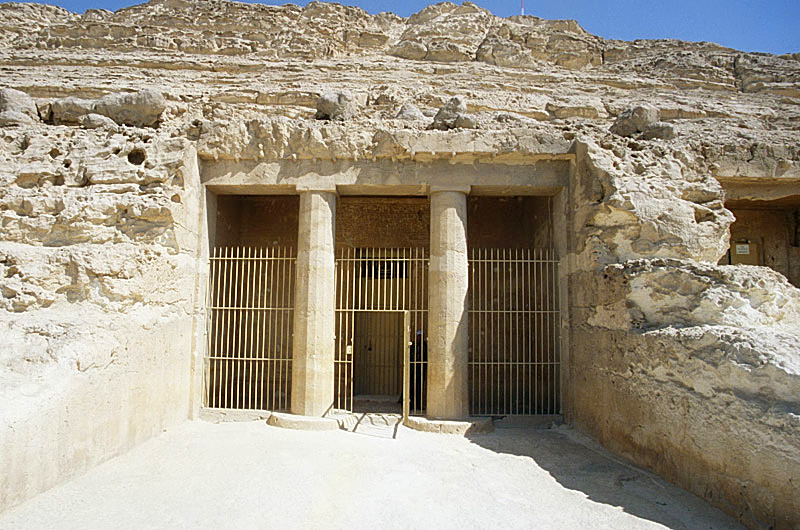
Tomb BH3 at the Beni Hasan cliff necropolis, situated on the eastern bank of the Nile approximately 250 kilometers south of Cairo, was cut for the nomarch Khnumhotep II during the reign of Pharaoh Senusret II (c. 1897–1878 BC), placing it firmly in Egypt's Twelfth Dynasty of the Middle Kingdom. The site was documented in the nineteenth century by Egyptologists including Percy Newberry, whose survey for the Egypt Exploration Fund produced the foundational published record of the tomb's painted register scenes. The tomb remains in situ within the rock-cut necropolis; detailed facsimile drawings and photographic archives are maintained at the Griffith Institute, Oxford. The caravan scene, painted on the north wall of the tomb's main chamber, depicts a procession of thirty-seven individuals identified by a hieroglyphic label as "Aamu" — an Egyptian ethnonym applied broadly to Semitic-speaking peoples of Canaan and the Levant. The figures, rendered with distinctive polychrome striped garments, sandals, and weapons including composite bows and throw-sticks, are led by a man named Absha. An accompanying inscription records the group bringing galena (eye-pigment) to Egypt during regnal year six of Senusret II. The scene's detail — including women, children, and donkeys — indicates a migrating clan rather than a military or trading delegation alone. For biblical scholarship, the painting contextualizes the Genesis accounts of Semitic groups descending into Egypt during periods of economic hardship, a pattern reflected in Abraham's sojourn (Genesis 12:10), the trade caravans of Genesis 37:25, and the extended migration of Jacob's family (Genesis 46:6). The painting does not identify any biblical figure but demonstrates that the movement of Levantine Semitic groups into Egypt was a historically documented phenomenon within the broad Middle Bronze Age period plausibly associated with the patriarchal era. It also illuminates the material culture — dress, weaponry, and goods — that would have characterized such migrations. The tomb and its imagery remain a standard reference point in discussions of Egyptian-Canaanite interaction during the second millennium BC. **Sources:** Percy E. Newberry, *Beni Hasan, Part I* (Egypt Exploration Fund, 1893); James K. Hoffmeier, *Israel in Egypt: The Evidence for the Authenticity of the Exodus Tradition* (Oxford University Press, 1997); Manfred Bietak, "Egypt and Canaan During the Middle Bronze Age," *Bulletin of the American Schools of Oriental Research* 281 (1991): 27–72; Genesis 12:10, 37:25, 46:6.
The Khnumhotep II caravan scene constitutes one of the earliest and most detailed Egyptian visual records of Semitic peoples entering Egypt, providing direct iconographic context for the ancestral migration narratives preserved in Genesis.