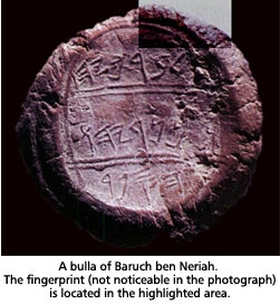
The second Berekhyahu ben Neriyahu bulla entered scholarly discussion when epigrapher Robert Deutsch published it in his 2003 volume on Hebrew bullae from the collections of his antiquities dealership and associated private holdings. Like the celebrated specimen acquired by Shlomo Moussaieff and subsequently studied by Nahman Avigad and published in 1978 in the Israel Exploration Journal, this second bulla is unprovenanced, meaning no controlled excavation context is recorded. The parallel Israel Museum bulla (IMJ 90.22.2399) remains the anchor specimen against which the second impression is compared. Both pieces are generally dated on paleographic and stratigraphic analogy to the late seventh or early sixth century BC, consistent with the final decades of the Judahite monarchy before the Babylonian destruction of Jerusalem in 586 BC. The second bulla is a small fired clay disk, comparable in scale to the Israel Museum example (roughly 17 mm in diameter), impressed from a stone or metal seal. Its two-line Hebrew inscription reads "[belonging] to Berekhyahu son of Neriyahu the scribe" (lbrkhyhw bn nryhw hspr), employing the lamed of ownership standard in West Semitic glyptic practice. The title hspr, "the scribe," corresponds precisely to the official designation applied to Baruch in Jeremiah 36:32 and related passages. A partial fingerprint preserved on the Israel Museum specimen has attracted further discussion, though authentication analysis of the second bulla has relied primarily on paleography and clay composition. The existence of two bullae bearing this identical inscription and title significantly strengthens the epigraphic case for Baruch ben Neriah as a historical official rather than a literary construct. The title hspr designates a professional scribe of administrative standing in the late-monarchic bureaucracy, contextualizing Baruch's role in dictating, preserving, and transmitting Jeremiah's oracles as described in Jeremiah 36 and 45. Taken together, the two bullae rank among the most direct onomastic links between Hebrew epigraphy and named individuals in the prophetic literature. **Sources:** Nahman Avigad, "Baruch the Scribe and Jerahmeel the King's Son," *Israel Exploration Journal* 28 (1978), 52–56; Robert Deutsch, *Biblical Period Hebrew Bullae: The Josef Chaim Kaufman Collection* (Archaeological Center Publications, 2003); Jeremiah 36:4, 36:32, 45:1–5; Lawrence J. Mykytiuk, *Identifying Biblical Persons in Northwest Semitic Inscriptions of 1200–539 B.C.* (Society of Biblical Literature, 2004).
A second clay bulla inscribed with the full name and title of Baruch ben Neriah, Jeremiah's scribe, provides independent epigraphic corroboration that this pivotal literary figure of the late-monarchic period was a historical individual holding a formal scribal office.