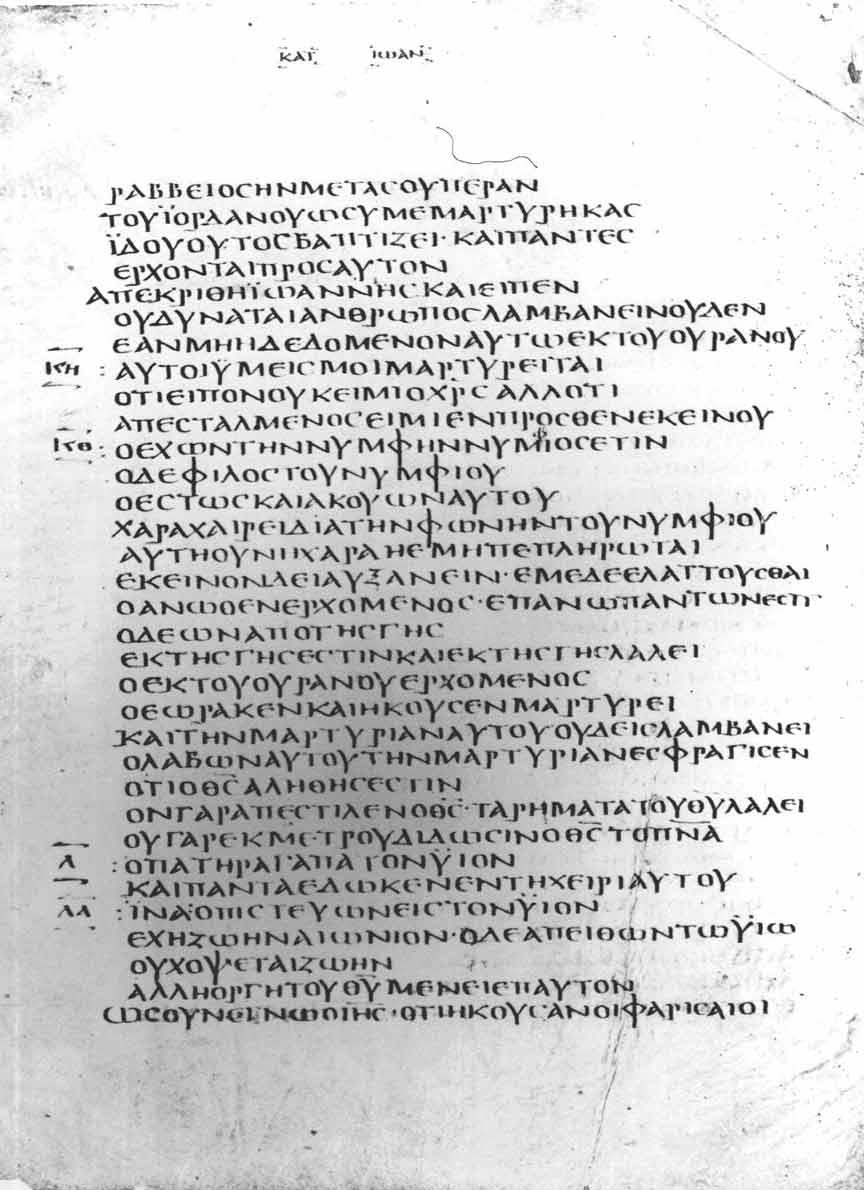
Codex Bezae Cantabrigiensis (Cambridge University Library, MS Nn.II.41) is a 5th-century parchment diglot — Greek on the left page, Latin on the right — containing most of the four Gospels (in the so-called Western order: Matthew, John, Luke, Mark) and most of Acts, with substantial lacunae. The codex came to Western scholarly attention through Theodore Beza, the Reformer who succeeded Calvin at Geneva. He acquired the manuscript in 1562 from the monastery of St. Irenaeus in Lyon during the religious wars and presented it to Cambridge University in 1581, where it has remained. What makes Bezae singular is its text. In Acts in particular, the Bezan text is roughly ten percent longer than the standard text known from Sinaiticus, Vaticanus, and Alexandrinus. It expands speeches, adds names and places, supplies motivations and explanations, and harmonizes details. The expansions are often vivid: Acts 12:10, where Peter is led out of prison, Bezae adds "they descended seven steps." Acts 19:9, Paul lectures at the school of Tyrannus "from the fifth hour to the tenth." These details are not later interpolations in a single manuscript; they belong to a recognized "Western" text-type witnessed in Old Latin manuscripts, Old Syriac, and quotations in Tertullian, Cyprian, and Irenaeus. Whether the Western text represents an early independent textual stream — perhaps even containing original readings — or a free 2nd-century revision remains debated. F. J. A. Hort judged it secondary; the more recent work of Jean Duplacy, Eldon Epp, and David Parker has rehabilitated some of its readings as potentially primitive. The codex remains chiefly a witness to how the New Testament text was being transmitted and revised in the 2nd century. Sources: D. C. Parker, Codex Bezae: An Early Christian Manuscript and Its Text (1992); J. Rendel Harris, A Study of Codex Bezae (1891); Bruce Metzger and Bart Ehrman, The Text of the New Testament (4th ed., 2005); Eldon J. Epp, The Theological Tendency of Codex Bezae Cantabrigiensis in Acts (1966).
The most important witness to the so-called Western text-type, valuable for textual criticism precisely because its readings often differ. Helps scholars triangulate the original wording of the New Testament across textual families.