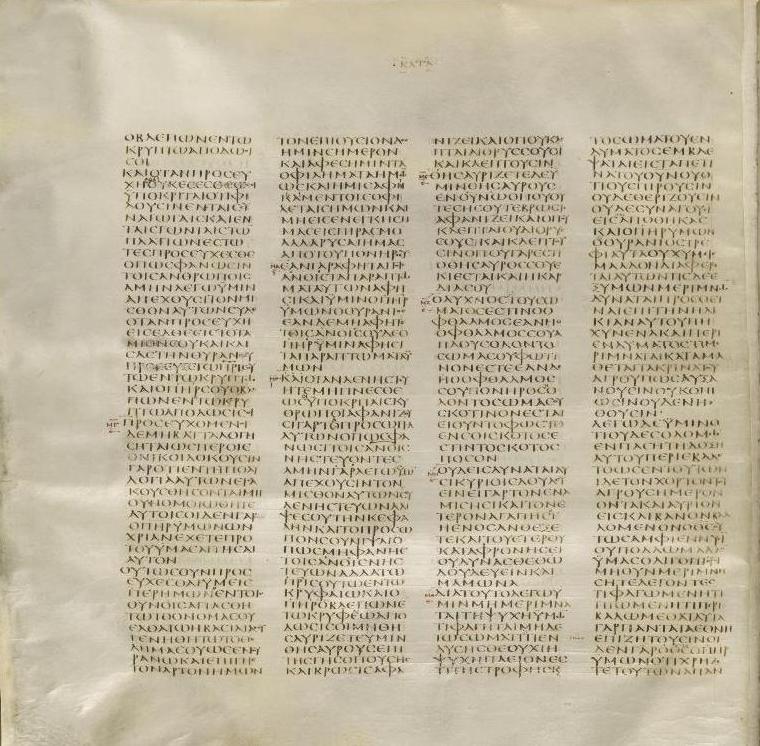
Constantin von Tischendorf, a German biblical scholar hunting ancient manuscripts, came to St. Catherine's Monastery at the foot of Mt. Sinai in 1844 and noticed parchment leaves in a basket destined — by his account — to feed a monastic stove. He returned in 1853 and again in 1859, when the monks finally produced the rest: a mid-4th-century Greek codex containing the entire New Testament, much of the Old Testament Septuagint, the Epistle of Barnabas, and the Shepherd of Hermas. Roughly 800,000 letters had been copied by three scribes on fine vellum, with later correctors entering thousands of variant readings. Sinaiticus broke open the textual history of the Greek New Testament. It is one of only two surviving 4th-century Bibles — Codex Vaticanus is the other — and it confirms that the books of the New Testament had stabilized in their canonical order well before the close of antiquity. Its presence of Barnabas and the Shepherd at the end shows that the boundary between authoritative scripture and edifying reading was still being negotiated in some quarters. The codex is now divided across four institutions — the British Library, the University of Leipzig, the Russian National Library, and St. Catherine's itself, which retrieved further leaves in 1975. The high-resolution Codex Sinaiticus Project published the complete text online in 2009. Tischendorf's removal of the manuscript remains contested by the monastery to this day. Sources: Constantin von Tischendorf, Codex Sinaiticus Petropolitanus (1862); D. C. Parker, Codex Sinaiticus: The Story of the World's Oldest Bible (2010); Bruce Metzger and Bart Ehrman, The Text of the New Testament (4th ed., 2005); Codex Sinaiticus Project (codexsinaiticus.org).
The earliest complete New Testament in existence, preserving every book Christians have used for two millennia. Its text is the foundation of every modern critical edition of the Greek New Testament.