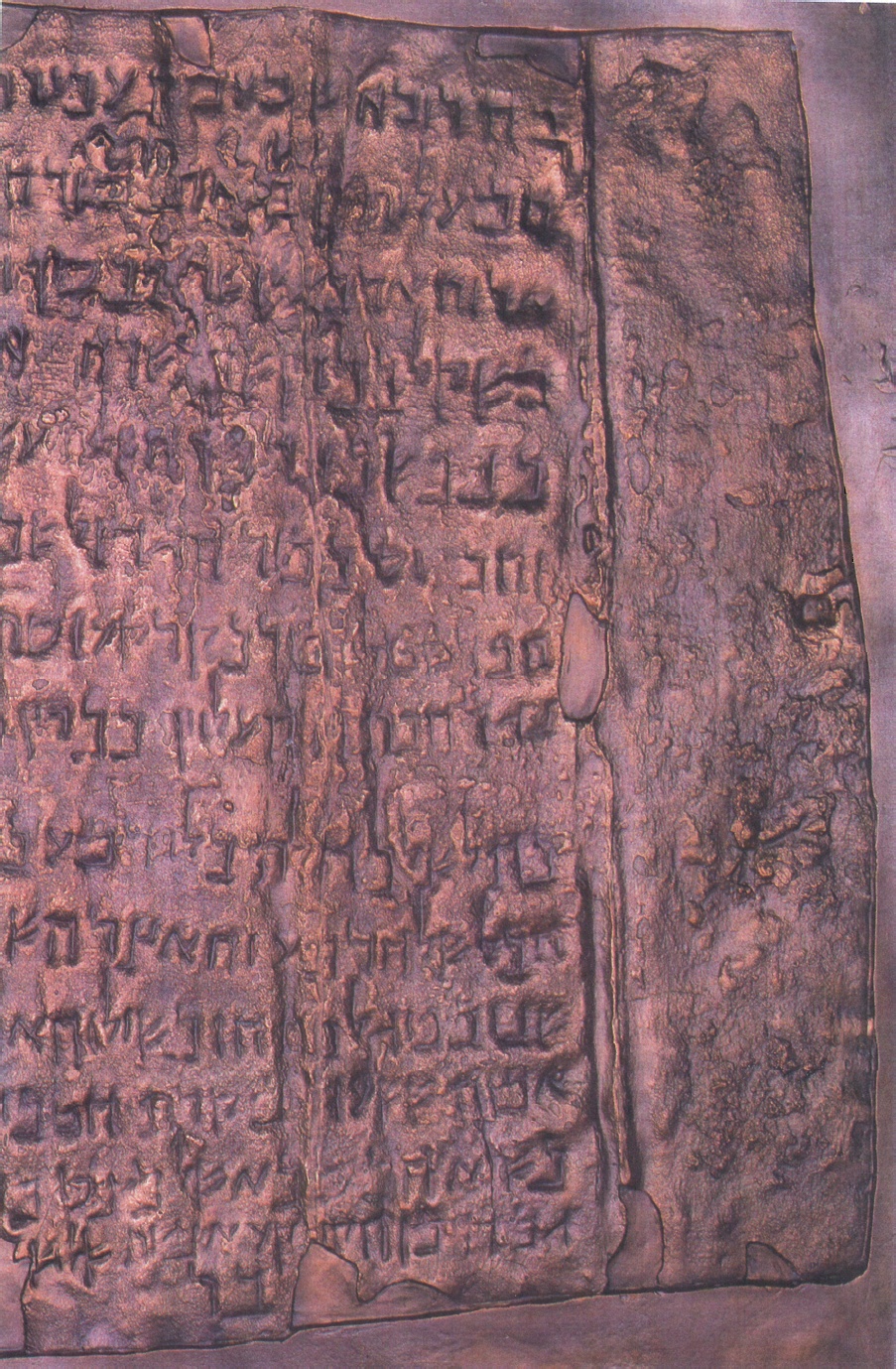
The Copper Scroll was discovered in March 1952 by archaeologists working under the direction of the École Biblique et Archéologique Française de Jérusalem within Cave 3 at Khirbet Qumran, on the northwestern shore of the Dead Sea. Because the oxidized metal could not be unrolled without destruction, it was cut into strips in 1955–1956 by H. Wright Baker at the Manchester College of Technology. The scroll subsequently entered the collection of the Palestine Archaeological Museum in East Jerusalem before being transferred to the Jordan Archaeological Museum in Amman and, more recently, to the Jordan Museum, where it remains on public display. The artifact comprises two rolls of nearly pure copper (approximately 99% copper with trace tin), originally riveted together, totaling roughly 2.4 meters in length and 30 centimeters in height. Its twelve columns of Hebrew text, incised rather than inked, enumerate sixty-four locations across the Judean landscape where gold, silver, vessels, and other valuables are allegedly concealed. The orthography and dialectal features of the Hebrew align with Mishnaic rather than classical Biblical Hebrew, suggesting a date in the first century AD. No canonical biblical text is quoted directly, though the inventory genre resonates with passages in Chronicles, Nehemiah, and Ezra concerning the stewardship and accounting of Temple treasuries. Scholars remain divided over whether the listed treasure is historical, legendary, or symbolic, but the scroll's significance for biblical study is independent of that question. It demonstrates that copper could serve as a scribal medium for documents deemed especially important, and it preserves a rich vocabulary of weights, measures, and place names that illuminates the economic and administrative world presupposed by late Second Temple literature. The topographical references have been compared with Josephus and rabbinic sources to map Judean geography in the Herodian and early Roman periods, deepening scholarly understanding of the material context in which the New Testament and late Hebrew Bible texts were produced. **Sources:** John Allegro, *The Treasure of the Copper Scroll* (Doubleday, 1960); Józef Milik, in *Discoveries in the Judaean Desert*, vol. 3 (Oxford University Press, 1962); Al Wolters, *The Copper Scroll: Overview, Text and Translation* (Sheffield Academic Press, 1996); Florentino García Martínez, *The Dead Sea Scrolls Translated*, 2nd ed. (Brill/Eerdmans, 1996).
The Copper Scroll is the only known ancient document listing specific quantities and locations of buried treasure, providing unparalleled evidence for Second Temple-era scribal conventions, Judean topography, and the administration of sacred or communal wealth outside canonical texts.