The Qumran library — 981 manuscripts in Hebrew, Aramaic, and Greek, discovered in eleven caves near the Dead Sea between 1947 and 1956. Every book of the Hebrew Bible is represented except Esther, and the earliest copies pre-date the Masoretic Text by a thousand years.
981
Manuscripts
11
Caves
3
Languages
3rd c. BC
Oldest
The Great Isaiah Scroll
1QIsaᵃc. 125 BC
The Israel Museum / Google Art Project (public domain) · source
A virtually complete copy of the book of Isaiah in Hebrew, 7.34 m long, found in Cave 1 at Qumran in 1947. It is the best-preserved biblical scroll from antiquity.
Why it matters — Before 1QIsaᵃ, the oldest complete Hebrew Isaiah was the Aleppo Codex (10th c. AD). The Qumran scroll is roughly a thousand years older and agrees with the Masoretic Text to a remarkable degree — chapter 53 is almost identical word-for-word, with variants that are overwhelmingly orthographic rather than theological.
The ordering charter of the Qumran yaḥad (community) — entry rituals, disciplinary code, hymnic sections, and dualistic teaching on the Two Spirits.
Why it matters — Gives the clearest window into the self-understanding of a Second Temple Jewish sect: ritual purity, communal property, daily prayer hours, and Messianic expectation. Terminology parallels (not sources) show up in New Testament ethics and ecclesiology.
CD / 4Q266–273Cairo Geniza copies medieval; Qumran fragments 1st c. BC
The Israel Museum / Wikimedia Commons (public domain) · source
A two-part document (exhortation + laws) first recovered from the Cairo Geniza in 1896, then confirmed at Qumran with ten fragmentary copies from Caves 4, 5, and 6.
Why it matters — Demonstrates that the Qumran movement had roots older and broader than the caves themselves — and gives us a full reform-program reading of Torah alongside halakhic case law. The 'Teacher of Righteousness' figure appears here and in the Pesharim.
Photo: israeltourism / Wikimedia Commons (CC BY 2.0) · source
A 19-column tactical manual for the final war between the Sons of Light and the Sons of Darkness — trumpet signals, banners, priestly blessings, and angelic reinforcements.
Why it matters — The clearest surviving Jewish apocalyptic battle liturgy from the Second Temple period. Illuminates the military-eschatological vocabulary shared with Daniel, parts of Revelation, and the Synoptic Little Apocalypse.
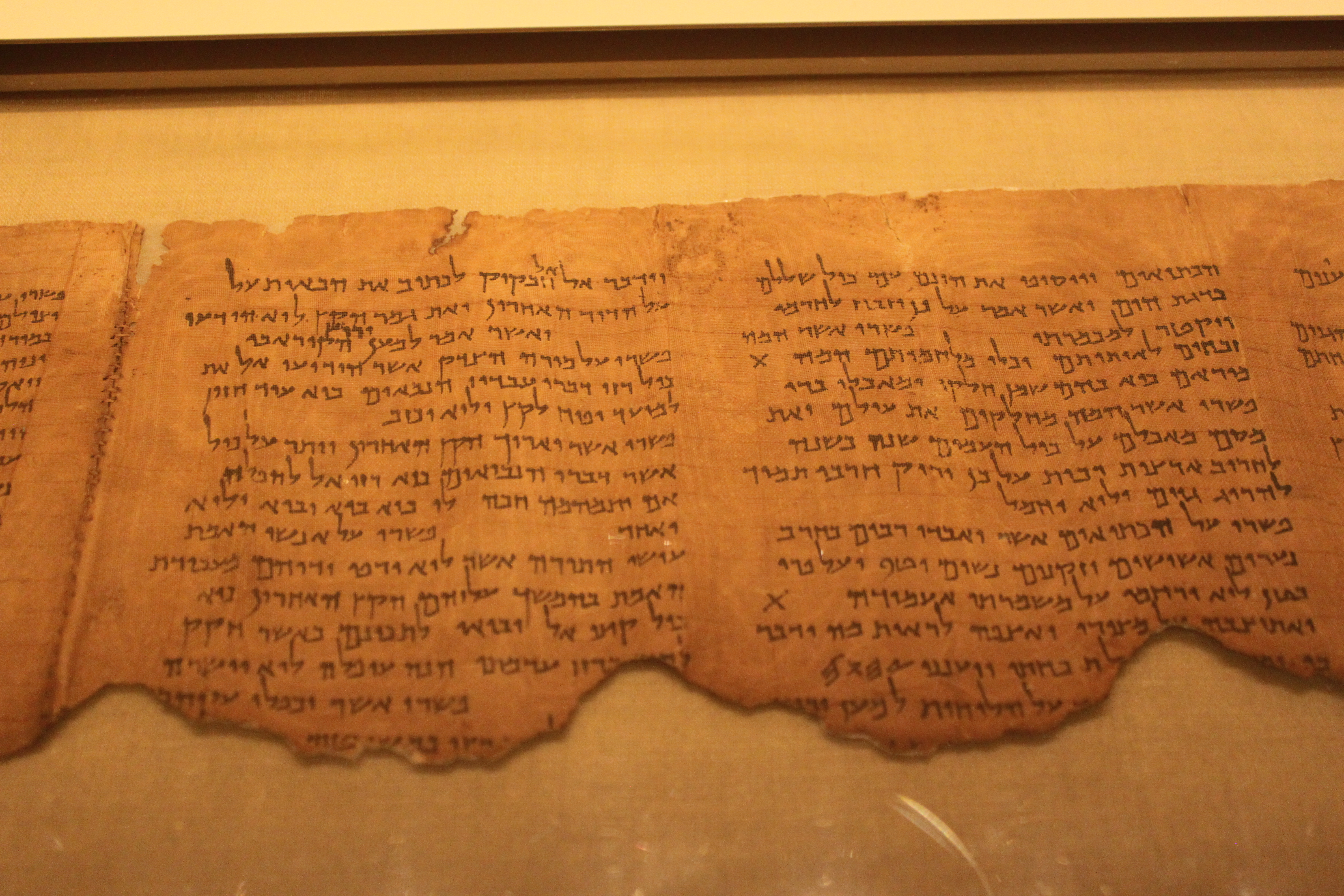
The Habakkuk Pesher
1QpHabLate 1st c. BC
The Israel Museum / Wikimedia Commons (public domain) · source
A line-by-line commentary on Habakkuk 1–2 applying the prophet's oracles to the Qumran community's own history — the Teacher of Righteousness, the Wicked Priest, and the Kittim.
Why it matters — The most important example of the pesher genre: a Jewish interpretive method that reads scripture as coded commentary on the interpreter's present. Essential background for New Testament uses of Habakkuk 2:4 (Rom 1:17, Gal 3:11, Heb 10:38).
The Temple Scroll
11QT / 11Q19c. 100 BC
The Israel Museum / Google Art Project (public domain) · source
The longest of the Dead Sea Scrolls at 8.6 m — a rewritten Torah that reorganizes Deuteronomy, Exodus, and Leviticus into a first-person Torah-from-God on temple architecture, festivals, purity, and the king.
Why it matters — Uniquely blends halakha, temple blueprint, and festival calendar into a single document. Preserves a 364-day solar calendar distinct from the rabbinic lunar one — and witnesses an alternative Second Temple vision that never became mainstream.
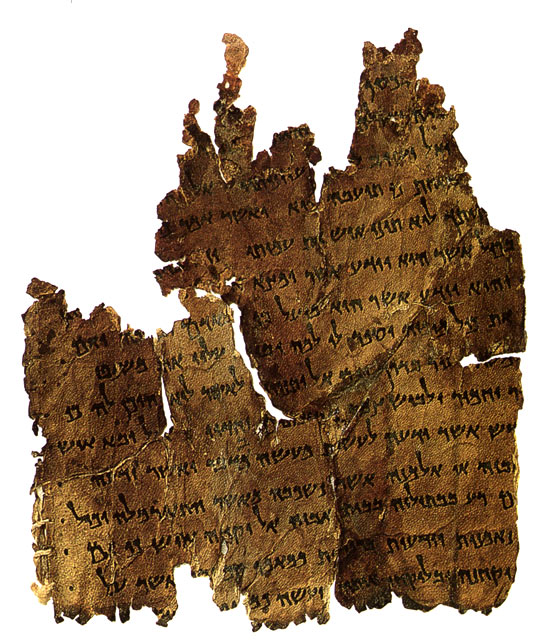
Cave 4 Fragments
4Q1 – 4Q575Various, 3rd c. BC – 1st c. AD
Photo: Mary Harrsch / Oriental Institute Museum, U. of Chicago (CC BY-NC-SA 2.0) · source
The largest single haul of Qumran material — over 15,000 fragments from some 575 manuscripts, including biblical, apocryphal, sectarian, and previously-unknown works (4QInstruction, 4QMMT, 4QFlorilegium).
Why it matters — Every book of the Hebrew Bible is represented in the Qumran corpus except Esther, and Cave 4 carries most of that weight. 4QMMT ('Some of the Works of the Law') is a halakhic letter that's reshaped scholarship on Second Temple Judaism's legal landscape and the Pauline phrase 'works of the law'.
Paleography & Dating
Most Qumran scrolls are dated by paleography (letter-form analysis) cross-checked with AMS radiocarbon dating of the leather and linen wrappings. The earliest manuscripts are 3rd c. BC (late Persian / early Hasmonean hands); the latest are from the Herodian period, terminating at AD 68 when the site was destroyed by the Romans.
Standard reference: Emanuel Tov, Scribal Practices and Approaches Reflected in the Texts Found in the Judean Desert (Brill, 2004).
_-_Google_Art_Project.jpg)
.jpg)
.jpg)
_-_Google_Art_Project.jpg)
