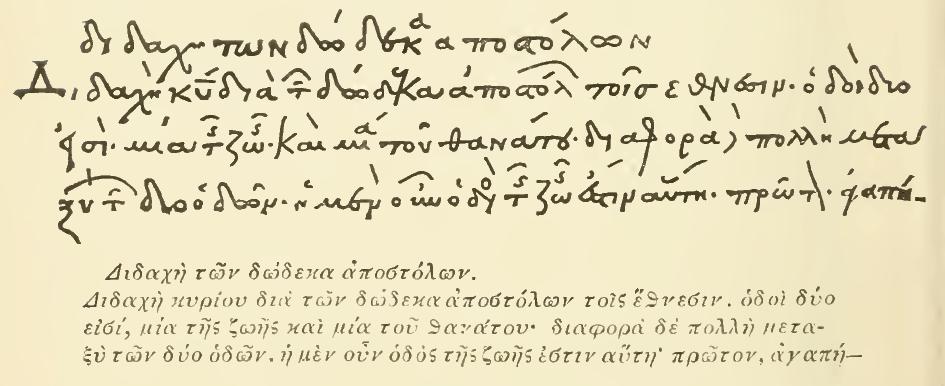
The Didache — Greek for "Teaching" — is a brief church order document setting out instructions for baptism, the Eucharist, fasting, prayer, hospitality to traveling teachers, and church organization. The work was lost to the Western world for roughly 1,400 years until 1873, when the Greek Orthodox Metropolitan Philotheos Bryennios came across it in the library of the Holy Sepulchre Monastery in Constantinople, bound in an 11th-century manuscript that also contained 1 and 2 Clement. He published the editio princeps in 1883, and the find immediately reshaped the study of earliest Christianity. The text opens with the "Two Ways" — a moral catechism contrasting the way of life and the way of death — that has parallels in Jewish wisdom tradition and in the Epistle of Barnabas. It prescribes baptism "in the name of the Father and of the Son and of the Holy Spirit," preferably in running water, and gives the earliest extra-biblical Eucharistic prayers. It warns against itinerant prophets who linger more than two days or ask for money — "if he asks for money, he is a false prophet." Most scholars now date the Didache's composition to the late 1st century, with some sections perhaps drawing on earlier oral catechesis. Whether it was composed in Syria, Egypt, or Palestine remains debated; the agricultural imagery and the absence of Roman concerns favor a Syrian or rural Palestinian provenance. It is the earliest surviving Christian liturgical handbook. Sources: Philotheos Bryennios, editio princeps (1883); Aaron Milavec, The Didache: Faith, Hope, and Life of the Earliest Christian Communities (2003); Kurt Niederwimmer, The Didache: A Commentary (Hermeneia, 1998); Bart Ehrman, ed., The Apostolic Fathers, vol. 1 (Loeb, 2003).
The earliest surviving extra-biblical Christian document. Shows what church practice looked like in the apostolic generation — including a liturgical Eucharist, threefold-immersion baptism, and an explicit "Two Ways" moral catechism — confirming that practices later dismissed as medieval inventions were apostolic.