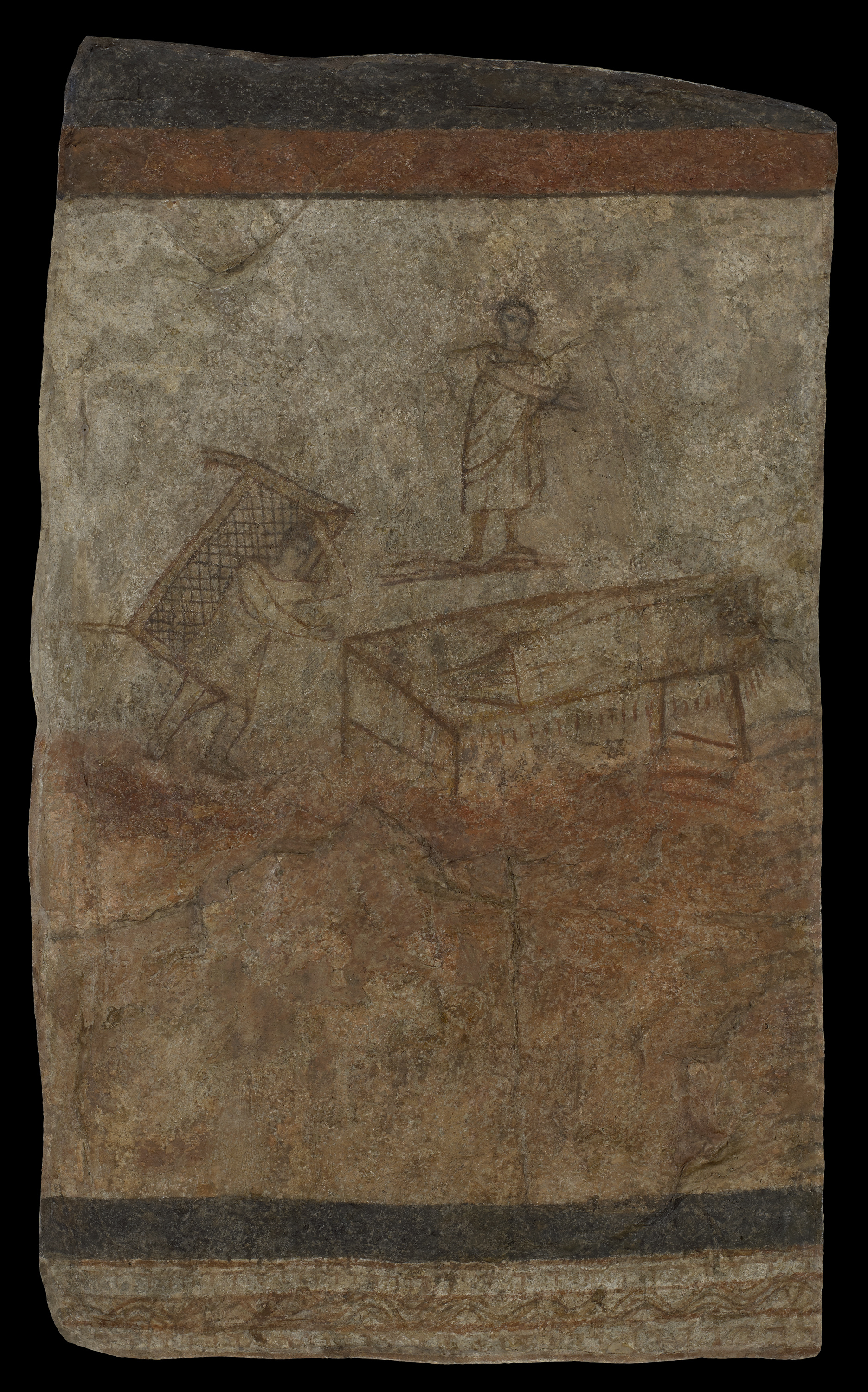
Dura-Europos sat on the right bank of the Euphrates in eastern Syria as a Roman frontier garrison facing the Sasanian Persian Empire. In AD 256 a Persian army under Shapur I besieged the city; the defenders heaped an earthen rampart against the western wall to thicken it against undermining, burying the buildings within it. The Persians sacked the town shortly after, and Dura was abandoned. The earthen rampart preserved the buildings beneath it almost unchanged. Excavations conducted jointly by Yale University and the French Academy of Inscriptions ran from 1928 to 1937 under the direction of Michael Rostovtzeff and Clark Hopkins. The frozen city yielded the world's oldest known Christian house-church (a private home converted around AD 232-241 into a Christian gathering place, with a baptistery decorated with frescoes of Christ healing the paralytic, walking on water, and the Marys at the empty tomb), the oldest known synagogue with figurative wall painting (extensive narrative cycles from the Hebrew Bible), and shrines to Mithras, Bel, and the Palmyrene gods. The Christian baptistery paintings predate any other surviving Christian figurative art by two generations, and they confirm that the early church — even before Constantine — produced narrative imagery of Christ. The wall paintings and architectural elements were lifted and conserved during excavation; the Christian baptistery was reassembled at Yale University Art Gallery, where it remains on permanent display. Dura's archaeological deposits at the site itself were heavily looted during the Syrian civil war beginning in 2011. The Yale reconstruction is now the principal surviving record. Sources: Clark Hopkins, The Discovery of Dura-Europos (1979); Michael I. Rostovtzeff et al., The Excavations at Dura-Europos: Preliminary Reports (1929-1952); Lucinda Dirven, ed., Religious Identity in Late Antiquity: Dura-Europos and Its Surroundings (2013); Robin M. Jensen, Understanding Early Christian Art (2000).
The earliest physical remains of Christian worship space, predating Constantine by ~80 years. The frescoes are the oldest known Christian art, showing what 3rd-century Christians believed, taught, and pictured before the Roman state took an interest.