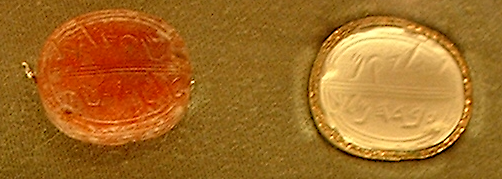
The Seal of Elyaqin, Servant of the King is a small inscribed Hebrew seal dated paleographically to approximately 850–700 BC, placing it within the Iron Age IIB–IIC horizon of the divided monarchy. The seal bears a two-line inscription reading 'belonging to Elyaqin, servant of the king' (le-Elyaqin 'eved ha-melekh), employing the well-attested title 'eved ha-melekh ('servant of the king'), a designation that appears on a number of contemporaneous Hebrew seals and bullae and denotes a high-ranking royal official rather than a domestic servant. The artifact is held in the collection of the Museum of Fine Arts, Boston. Its precise findspot is unrecorded, as it entered collections through the antiquities market rather than a controlled excavation, which limits conclusions about its geographic and administrative context. The name Elyaqin (meaning 'God establishes') is directly cognate with the biblical name Eliakim. A royal official named Eliakim son of Hilkiah appears in 2 Kings 18:18 and Isaiah 36:3 as the palace administrator (literally 'over the house') under King Hezekiah, roughly late 8th century BC. Isaiah 22:20–21 records an oracle addressed to Eliakim ben Hilkiah, describing his investiture with authority over the royal household. Whether this seal belonged to that specific Eliakim or to another official of the same name in Israel or Judah cannot be established; the name was not uncommon, and no patronymic appears on the seal to enable identification. The seal nonetheless attests the administrative infrastructure and titulary practices that the biblical text presupposes. Sources: Museum of Fine Arts, Boston (accession records); Nahman Avigad and Benjamin Sass, Corpus of West Semitic Stamp Seals (1997); Israel Exploration Journal (various seal studies).
This seal provides direct epigraphic evidence for the title and name-form associated with a prominent biblical royal official, illustrating the administrative structures of the Israelite and Judahite monarchies that underlie the narratives of 2 Kings and Isaiah. While the seal cannot be confidently linked to the specific Eliakim ben Hilkiah of Hezekiah's court, it corroborates the historicity of the official title and naming conventions described in those texts.