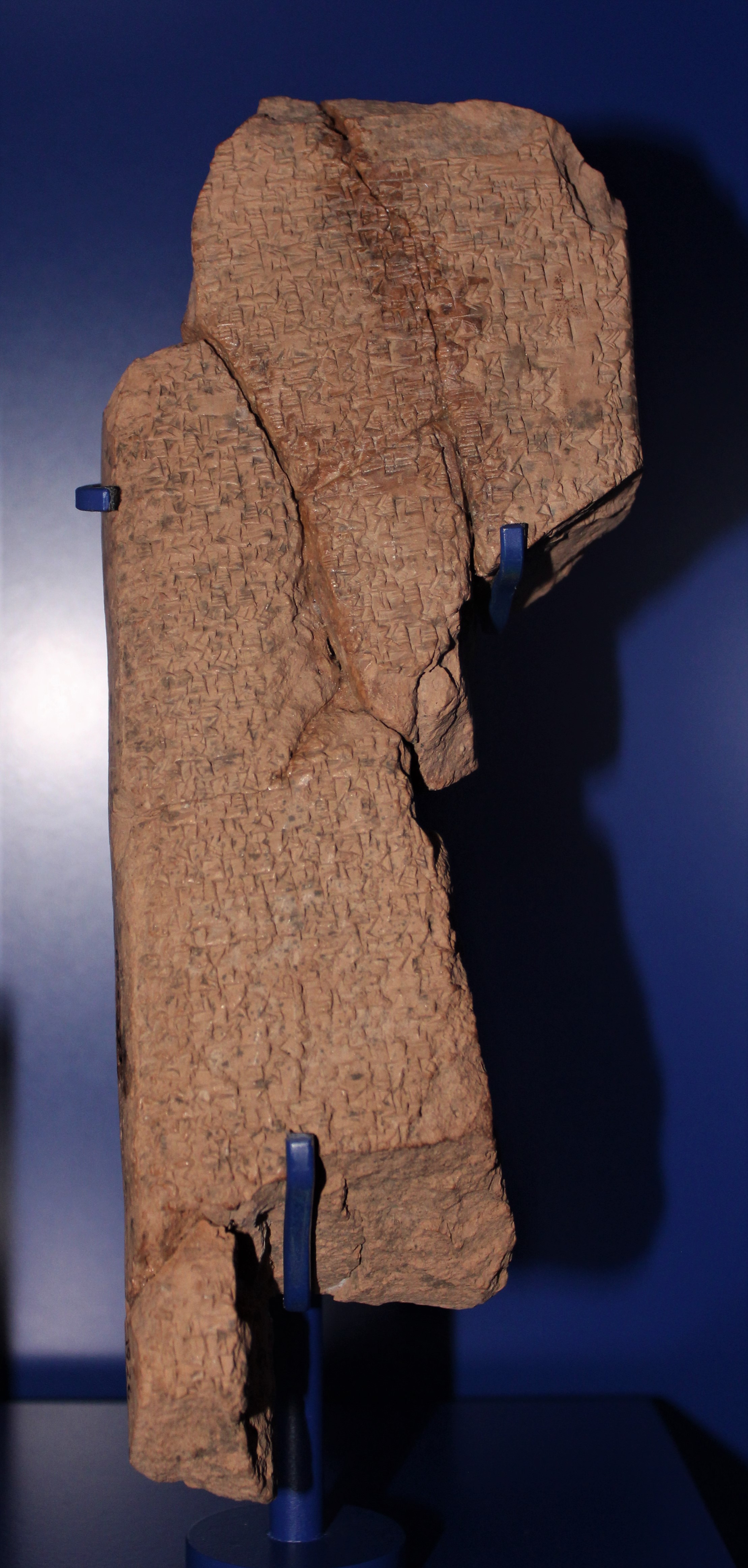
The Enuma Elish was recovered primarily from the library of the Assyrian king Ashurbanipal at Nineveh (modern Kuyunjik, Iraq), excavated by Austen Henry Layard and Hormuzd Rassam between 1848 and 1876. The tablets entered the British Museum collection, where George Smith first identified and published the text in 1875–1876. Additional exemplars have since been recovered from Ashur, Kish, and Uruk, indicating the epic enjoyed wide scribal circulation across Mesopotamia from roughly the twelfth century BC onward, though the composition likely reflects earlier Old Babylonian traditions. The epic is preserved across seven clay tablets written in Akkadian cuneiform, totaling approximately 1,100 lines. It narrates the emergence of the gods from primordial commingled waters (Apsu and Tiamat), the eventual combat between the god Marduk and Tiamat, and the formation of the cosmos from Tiamat's divided body — sky and earth — followed by the creation of human beings from the blood of the rebel god Kingu. Scholars note structural and lexical correspondences with Genesis 1: the shared motif of watery chaos preceding ordered creation, the division of waters (cf. Genesis 1:6–8), the sequence of light before luminaries, and the seven-part narrative structure concluding with divine rest or exaltation. The Enuma Elish does not suggest literary borrowing in any simple directional sense; rather, it establishes that Genesis 1 employs cosmological imagery and vocabulary widely shared across ancient Near Eastern scribal culture. The biblical account's distinctive features — a single, unchallenged deity creating by spoken word, the absence of theogony, and the non-divine status of the heavenly bodies — emerge more sharply when read against this Mesopotamian backdrop. The text thus remains indispensable for contextualizing the theological rhetoric of Genesis 1 within its historical environment. **Sources:** W.G. Lambert, *Babylonian Creation Myths* (Eisenbrauns, 2013); John H. Walton, *The Lost World of Genesis One* (IVP Academic, 2009); Alexander Heidel, *The Babylonian Genesis* (University of Chicago Press, 1951); Genesis 1:1–2:3.
The Enuma Elish preserves the closest known ancient Near Eastern literary parallel to Genesis 1, illuminating the shared cosmological vocabulary of primordial waters, divine speech, and ordered creation within which the biblical text was composed and received.