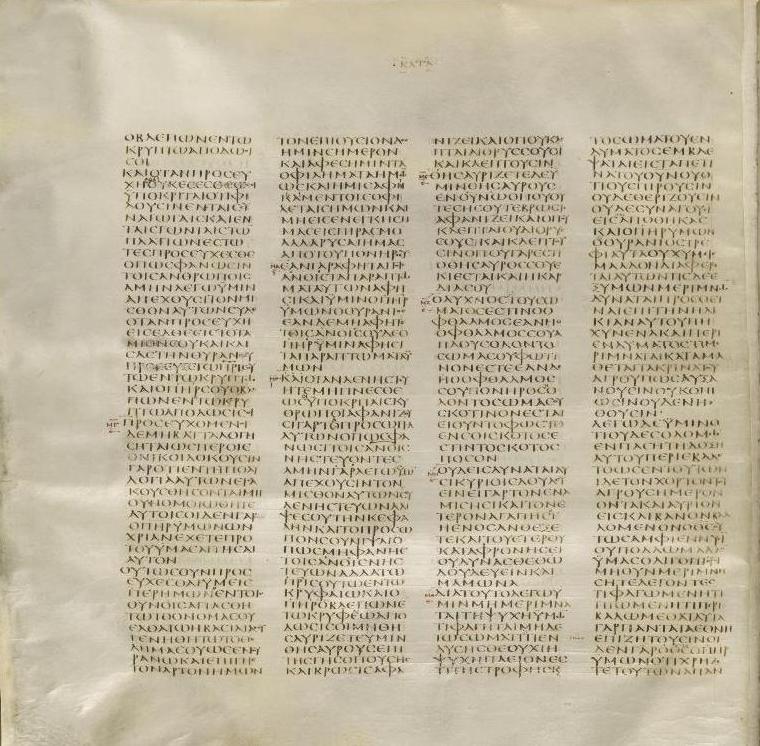
Codex Sinaiticus, the oldest nearly complete Christian Bible manuscript, was discovered at St. Catherine's Monastery on the Sinai Peninsula beginning in 1844, when Constantin von Tischendorf retrieved 43 leaves now held at Leipzig University Library. Subsequent acquisitions and negotiations brought the majority of the codex to the British Library in 1933 (Add MS 43725), with additional leaves retained at St. Catherine's and the National Library of Russia, St. Petersburg. The Epistle of Barnabas appears at the close of the New Testament section, following the Shepherd of Hermas, establishing its elevated status in certain fourth-century communities. The codex is a parchment manuscript produced in the mid-fourth century AD, approximately 38 cm × 34 cm per leaf, written in four columns in Greek uncial script. The Epistle of Barnabas occupies folios within the New Testament block and comprises twenty-one chapters. The text engages extensively with the Hebrew scriptures—particularly Leviticus, Isaiah, and the Psalms—deploying an allegorical hermeneutic to reinterpret Mosaic law and Israelite history as prefigurations of Christ. It explicitly cites and rewrites passages such as Isaiah 53 and references the covenant traditions of Jeremiah 31, arguing that Israel forfeited its covenant at Sinai and that the scriptures were always intended for the new community of believers. For biblical scholarship, the Epistle of Barnabas preserved in Codex Sinaiticus is significant on multiple levels. Its placement within the codex reflects debates over canon formation in the eastern Mediterranean during the third and fourth centuries AD. The text's dense engagement with the Old Testament demonstrates how early Christian communities read and appropriated Jewish scriptural traditions, offering a window into allegorical exegetical methods that predate and inform later patristic interpretation. Tischendorf's critical edition and subsequent diplomatic editions have made the Barnabas text central to study of early Christian canon history. **Sources:** Tischendorf, *Codex Sinaiticus Petropolitanus* (Leipzig, 1862); Ehrman, *The Apostolic Fathers*, Loeb Classical Library, vol. 2 (Harvard University Press, 2003); Metzger, *The Canon of the New Testament* (Clarendon Press, 1987); Isaiah 53:1-12; Jeremiah 31:31-34.
The inclusion of the Epistle of Barnabas in Codex Sinaiticus documents its circulation alongside canonical texts in the fourth century, revealing the fluid boundaries of early Christian scriptural collections and the text's role in allegorical Old Testament interpretation.