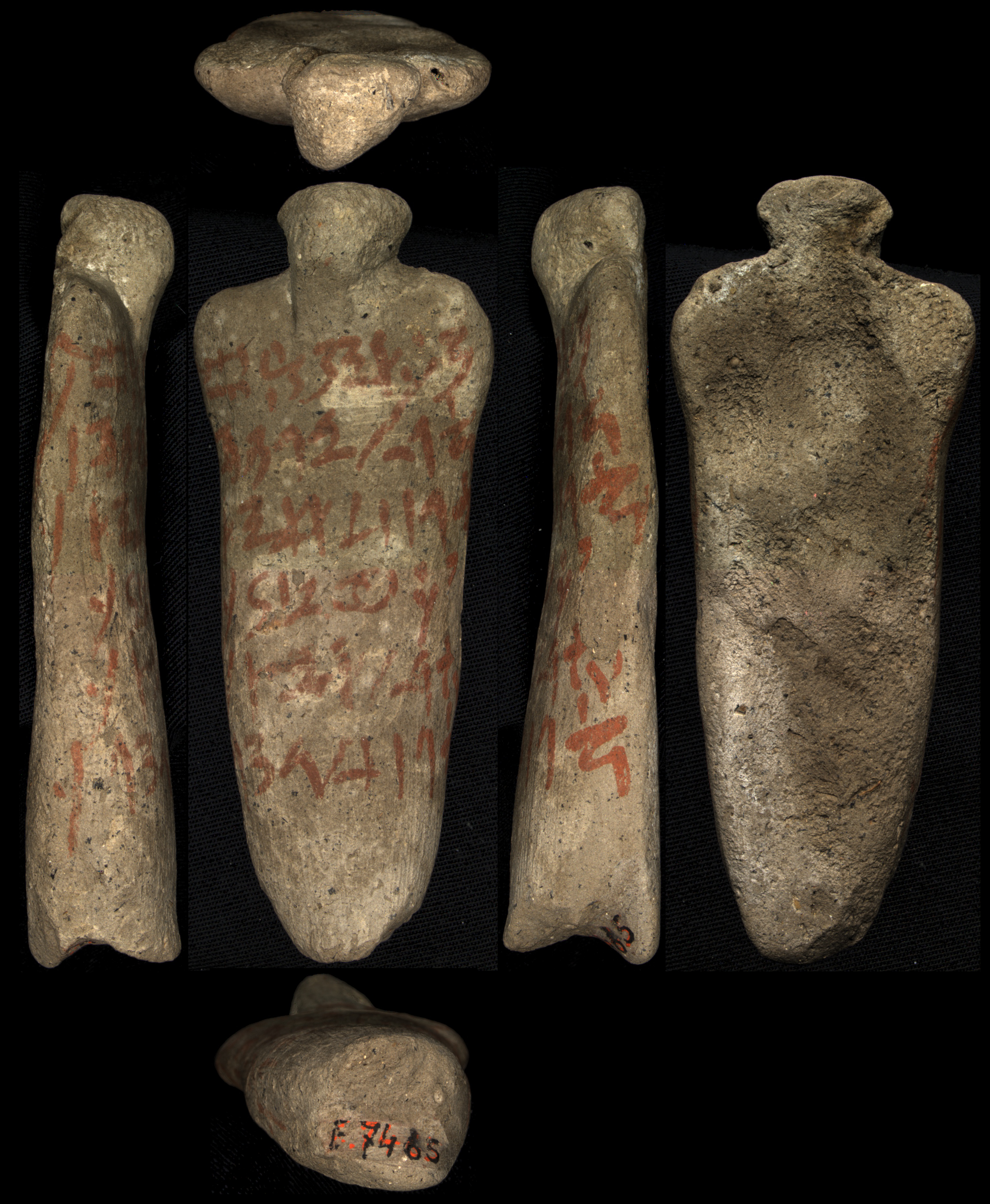
The Execration Texts comprise two principal groups of Egyptian ritual inscriptions dating to the Middle Kingdom period, roughly 2000–1750 BC. The earlier group, published by Kurt Sethe in 1926, consists of pottery bowls inscribed with hieratic curses and then shattered; these were acquired through antiquities markets and entered the collections of the Ägyptisches Museum in Berlin. The later group, analyzed by Georges Posener and published in 1940, involves fired clay figurines in human form—bound captives—similarly inscribed and ritually broken, now held primarily in Brussels and Cairo. Neither group derives from controlled stratigraphic excavation, but their paleographic and formulaic features support a confident Middle Kingdom dating. The texts enumerate foreign rulers and their cities as enemies of the Egyptian crown, invoking ritual destruction upon them. Among the toponyms listed are Jerusalem (Egyptian *Rušalimum*), Shechem, Ashkelon, and other Levantine centers. The figurines and bowls range from roughly 15 to 30 cm in height, inscribed in cursive hieratic script with formulaic imprecations. The biblical city of Jerusalem appears in the Sethe bowls with two rulers named, suggesting a dual or co-regency chieftainship; the Posener figurines list a single ruler for Jerusalem, indicating possible political consolidation by the later phase. Shechem appears correspondingly, prefiguring its role in the patriarchal narratives of Genesis 33–34 and the later traditions of Judges 9. For biblical scholarship, the Execration Texts establish that Jerusalem and Shechem were functioning urban or proto-urban polities in Canaan well before the Israelite settlement period, providing a political geography consistent with the world presupposed by the patriarchal narratives and the conquest accounts of Joshua. They also illuminate Egyptian imperial oversight of Canaan during the Middle Bronze Age, situating references such as Melchizedek's kingship in Genesis 14:18 within a historically plausible Canaanite city-state system. The texts remain a standard reference point in Bronze Age Levantine studies. **Sources:** Kurt Sethe, *Die Ächtung feindlicher Fürsten, Völker und Dinge auf altägyptischen Tongefäßscherben* (Verlag der Akademie der Wissenschaften, 1926); Georges Posener, *Princes et pays d'Asie et de Nubie* (Fondation Égyptologique Reine Élisabeth, 1940); William F. Albright, "The Egyptian Correspondence of Abimilki, Prince of Tyre," *Journal of Egyptian Archaeology* 23 (1937); Manfred Görg, "Jerusalem in den Ächtungstexten," in *Ägypten und Levante* 6 (1996); Genesis 14:18; Joshua 10:1.
The Execration Texts provide the earliest extrabiblical attestation of Jerusalem and Shechem as recognized Canaanite political entities during the Middle Bronze Age, directly contextualizing the patriarchal and conquest narratives within a documented geopolitical landscape.