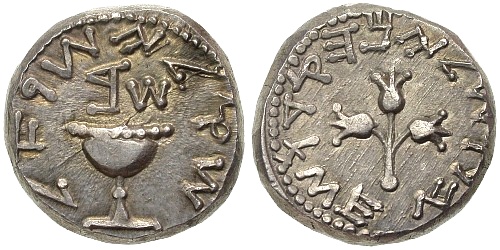
The Year 2 silver shekel is a coin struck at Jerusalem during the second year of the First Jewish Revolt against Rome, corresponding to AD 67–68. Minted from high-quality silver, the coin bears a paleo-Hebrew inscription reading 'Shekel of Israel' on the obverse alongside a chalice or omer cup, while the reverse displays a branch bearing three pomegranates accompanied by the inscription 'Jerusalem the Holy.' The use of the ancient paleo-Hebrew script was a deliberate ideological choice by the revolt's leadership, evoking the pre-exilic heritage of Israel and asserting political and religious independence from Roman authority. These shekels were struck across five annual issues (Years 1–5, AD 66–70), with Year 1 and Year 2 specimens being among the more commonly encountered. Findspots are concentrated in Judaea, with examples recovered from hoards associated with destruction layers corresponding to the Roman siege, including contexts at Masada and Jerusalem itself. The coin carries no Roman iconography whatsoever—no emperor's portrait, no Latin text—marking a sharp symbolic break from the provincial coinage that normally circulated in Judaea. In the New Testament, Matthew 24:1–2 and Luke 21:20–24 record Jesus forecasting the destruction of the Temple and the siege of Jerusalem; these coins were being struck in the very years the events Jesus described were unfolding, providing tangible material context for that period. They do not validate the prophecy, but they independently document the administrative and ideological circumstances of the revolt. Sources: Israel Museum (Jerusalem); Ya'akov Meshorer, 'A Treasury of Jewish Coins' (2001); David Hendin, 'Guide to Biblical Coins,' 5th ed. (2010); Israel Numismatic Journal.
The Year 2 shekel offers direct numismatic evidence of the Jewish revolt's self-governing aspirations and its temple-centered religious identity at the precise historical moment the siege of Jerusalem was approaching, grounding the New Testament's account of that era in independently attested material culture.