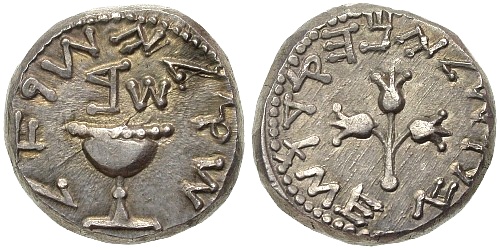
A silver shekel, 22mm across and weighing roughly fourteen grams, struck at Jerusalem during the fifth and final year of the First Jewish Revolt against Rome. The obverse depicts a chalice — long identified as the Temple chalice — above the date marker. The Hebrew paleo-script legend reads shekel yisrael — "shekel of Israel" — and beside the chalice the year mark shin-heh, year 5. The reverse shows three pomegranates branching from a single stem, with the legend yerushalayim ha-kedoshah — "Jerusalem the Holy." The script is Hebrew, not the Aramaic that had become the everyday language of Judea. The choice was deliberate: the revolt minted in the sacred liturgical script of the Hebrew Bible itself. These are the only ancient coins ever struck with full Hebrew legends. The silver came from the Temple treasury — ninety-four percent purity, the same metallurgical fidelity as the Tyrian shekel that had been required for the Temple tax. Year 1 issues are AD 66, year 2 AD 67, year 3 AD 68, year 4 AD 69. The Year 5 issue was struck in spring AD 70, in the narrow window between Passover and the closing of the Roman siege under Titus. Within months the upper city would fall, the Temple would burn (9 Av, AD 70 — the date Josephus records and Jewish liturgy commemorates still), and Jerusalem would cease to mint coinage of any kind for sixty-two years. Year 5 shekels are accordingly very rare. Yaakov Meshorer's catalogue counted fewer than two dozen specimens at his last revision; subsequent finds have brought the total only marginally higher. They are the last sovereign coinage of Jerusalem before the Bar Kokhba revolt, and the last of any kind from the Second Temple itself. Holdings are dispersed across the Israel Museum, the American Numismatic Society in New York, the British Museum, the Bibliothèque nationale de France, and a handful of private cabinets that occasionally surface at auction. Sources: Yaakov Meshorer, A Treasury of Jewish Coins from the Persian Period to Bar Kokhba (Yad Ben-Zvi / Amphora, 2001); David Hendin, Guide to Biblical Coins (5th ed., Amphora, 2010); Josephus, Jewish War 6.220–270; Luke 21:20–24.
Struck in spring AD 70 during the final weeks before Titus closed the siege, the Year 5 shekel represents the last sovereign coinage Jerusalem ever produced. Its deliberate paleo-Hebrew legends and Temple-grade silver illuminate the revolt's ideological program and anchor numismatic chronology to the Temple's destruction.