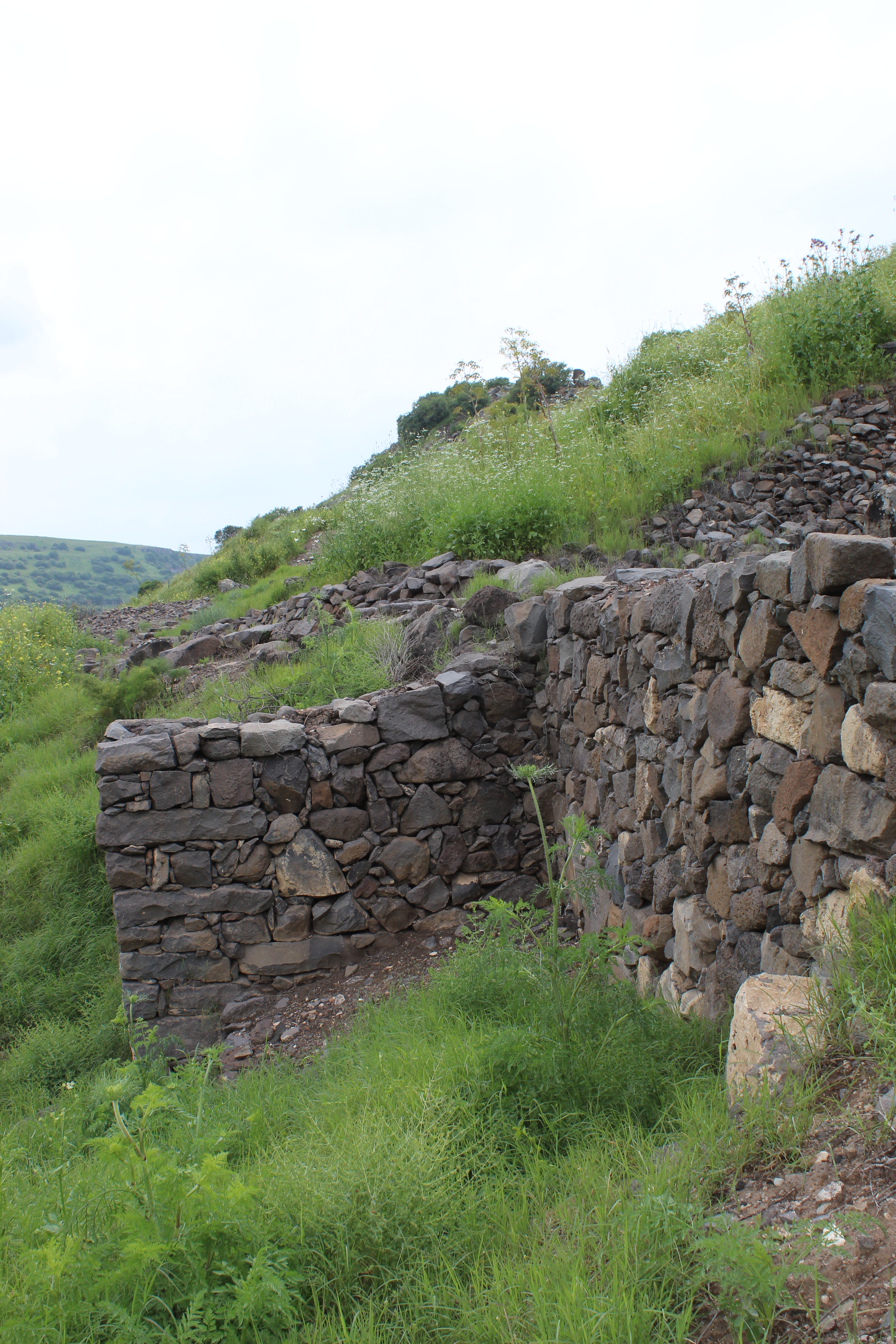
Gamla (modern Khirbet es-Salam) is an archaeological site situated on a steep, spur-shaped ridge in the southern Golan Heights, occupied primarily from the second century BC through its violent destruction in AD 67. The site was excavated under Shmarya Gutman and later Dany Syon beginning in 1976, revealing a densely built town of roughly 9,000 residents at its peak, defended by a wall that exploited the near-vertical slopes on three sides. Gamla is identified in Josephus's 'Jewish War' as the scene of one of the most brutal engagements of the First Jewish–Roman War: Roman forces under Vespasian besieged the town, breached its walls, and, according to Josephus, killed or drove to their deaths some 4,000–5,000 inhabitants in AD 67. Excavations have corroborated a catastrophic, single-destruction event at that horizon, uncovering arrowheads, ballista stones, burned structures, and skeletal remains consistent with combat and mass death. A first-century synagogue—among the oldest archaeologically attested in Israel—was also uncovered, featuring stone benches and ritual installations. The site's connection to the scriptural record is indirect. Matthew 4:25 and Mark 5:1 reference Galilee and the Decapolis region more broadly; Gamla itself is not named in the New Testament. Some scholars situate Gamla within the socio-political tensions that form the backdrop to Jesus's Galilean ministry, but no direct textual link is established. The town illustrates the volatile Roman-period Golan environment contemporaneous with the Gospels without serving as corroboration of any specific passage. Sources: Israel Antiquities Authority excavation reports (Gutman and Syon); Dany Syon, 'Gamla: City of Refuge,' in 'The First Jewish Revolt' (Routledge, 2002); Josephus, 'Jewish War' IV.1–83; Gamla Nature Reserve site documentation (Israel Nature and Parks Authority).
Gamla provides one of the most archaeologically well-documented examples of Roman siege warfare during the First Jewish–Roman War, illuminating the violent political climate of the Golan–Galilee region within which the New Testament era unfolded. Its intact first-century synagogue also contributes material evidence for Jewish communal religious life contemporaneous with early Christianity.