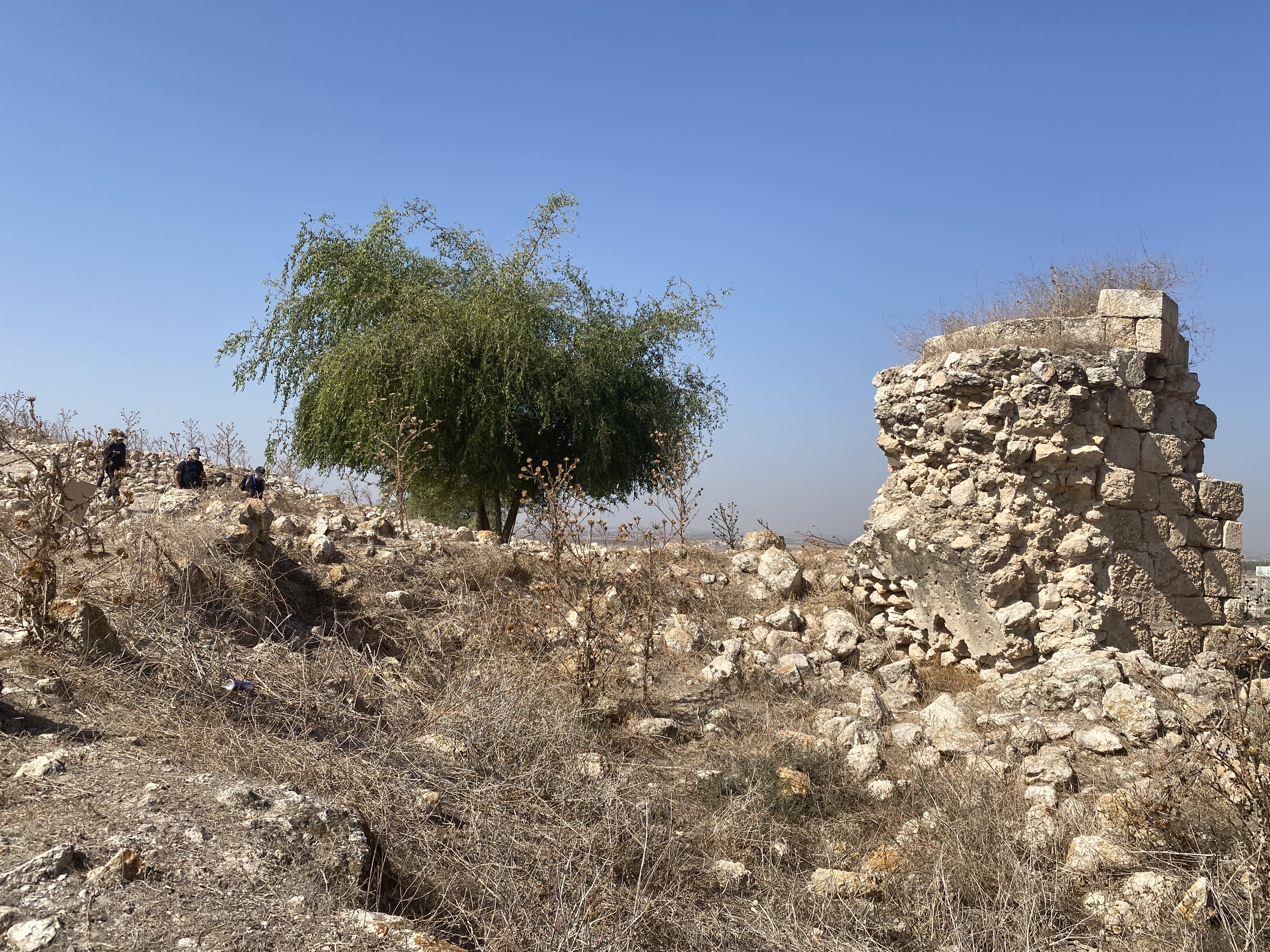
Tell es-Safi (Tel Zafit) sits on a prominent chalk ridge at the edge of the Shephelah, approximately 35 kilometers southwest of Jerusalem, overlooking the Elah Valley. Systematic excavations led by Aren Maeir of Bar-Ilan University since 1996 have established it as the largest Iron Age Philistine city yet identified, widely accepted among specialists as ancient Gath. The site preserves continuous occupation from the Chalcolithic period through the medieval era, but its Iron Age strata are particularly significant. At its height in Iron Age IIA (roughly the 10th–9th centuries BC), the city covered an estimated 50 hectares, making it substantially larger than contemporary Israelite urban centers. A destruction layer dated to approximately 830 BC, consistent with Hazael of Aram-Damascus's campaign recorded in 2 Kings 12:17, marks the abrupt end of Gath's prominence. The siege system uncovered at the site—including a massive trench—is among the most complete ancient siege works found in the southern Levant and corroborates the biblical account of the city's violent reduction. A late 10th-century BC inscribed potsherd bearing two non-Semitic names, 'ALWT and WLT, exhibits roots linguistically comparable to the name Goliath (Hebrew גָּלְיָת), a form fitting proposed Aegean or Anatolian Philistine onomastics. Scholars caution this does not identify any individual but does attest that such name patterns circulated at Iron Age Gath. The site also illuminates references in 1 Samuel 5:8 (Gath as a Philistine pentapolis member) and Amos 6:2 (Gath invoked as a fallen great city). Sources: Tell es-Safi/Gath Archaeological Project (Bar-Ilan University); Maeir, A.M., ed., *Tell es-Safi/Gath I* (2012); *Israel Exploration Journal*; Aren Maeir & Carl Ehrlich, 'Excavating Philistine Gath,' *Biblical Archaeologist* (2001).
Tell es-Safi provides the most substantial material evidence for Philistine urban culture at its peak, and its destruction layer independently corroborates the biblical notice of Hazael's campaign against Gath, while its inscriptional finds illuminate the onomastic world that produced names like Goliath.